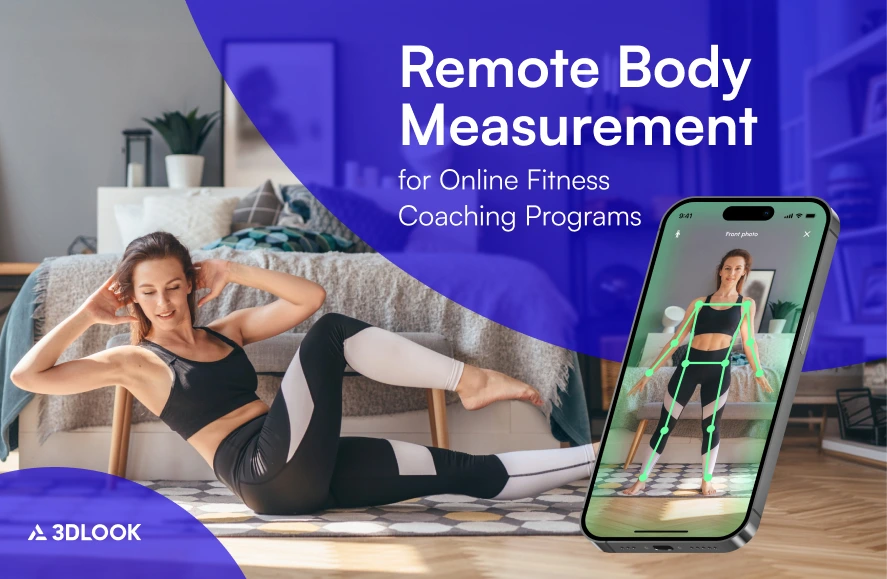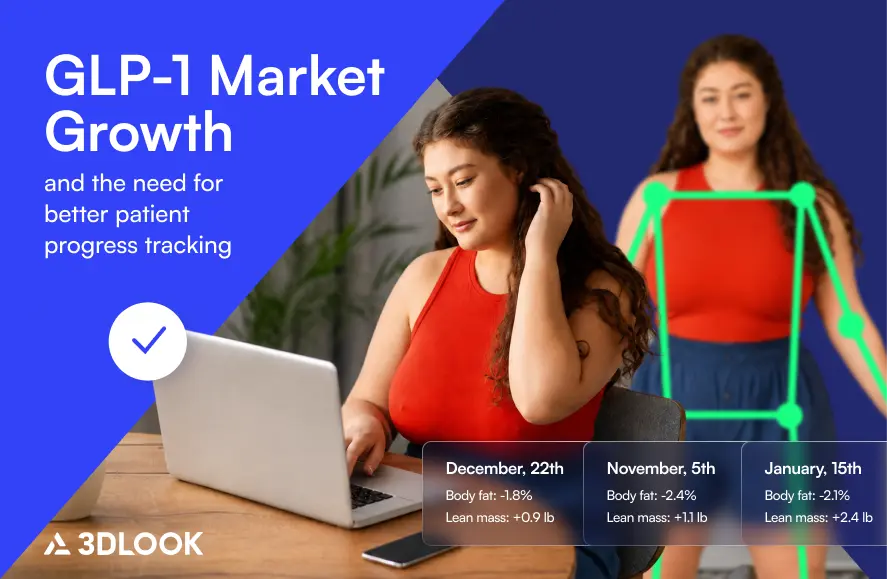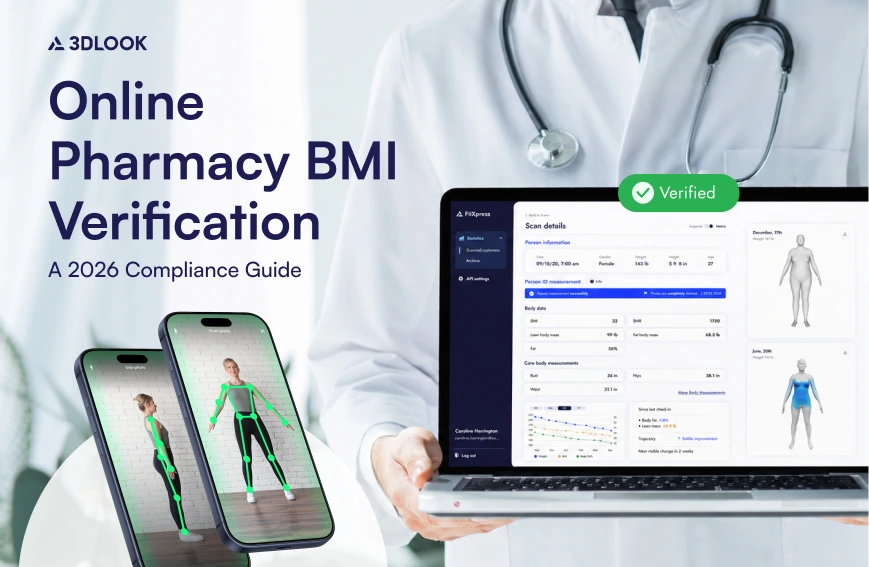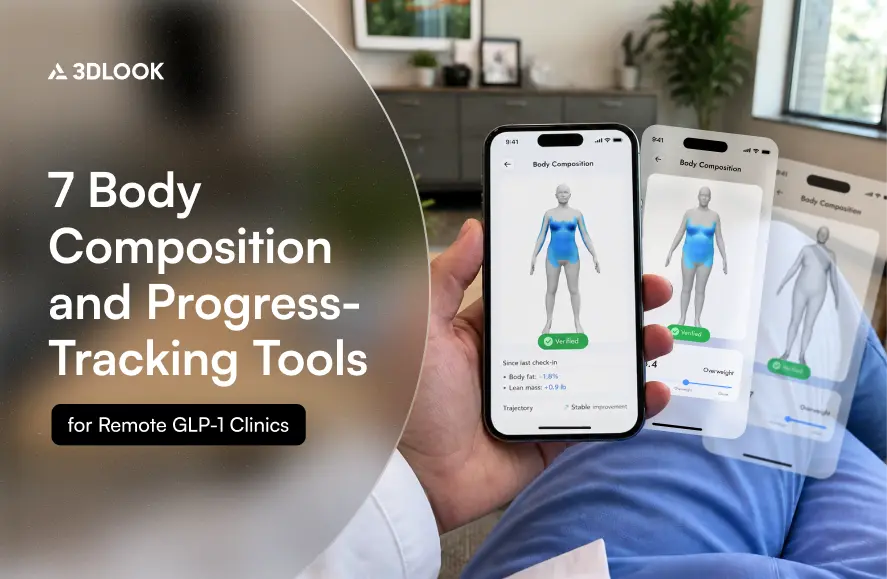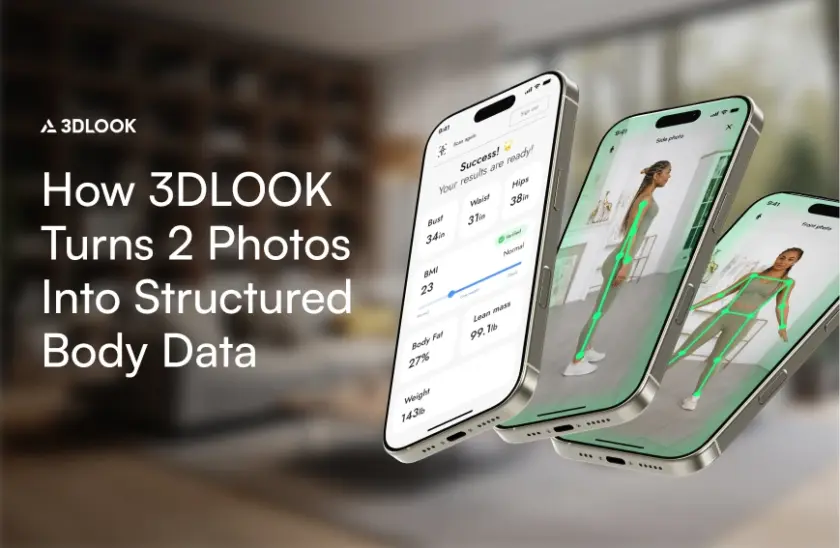
3DLOOK’s AI-powered computer vision technology transforms two photos into structured body data, supporting a wide range of use cases across apparel fit, body progress tracking, wellness, fitness, and weight loss. At a high level, two photos and a few supporting inputs go into 3DLOOK’s patented, proprietary system, which generates a range of outputs tailored to specific business needs.
This article explains what those outputs are and how they support different business and user needs.
How 3DLOOK technology works
3DLOOK combines two photos, guided framing, and AI-powered computer vision in a patented, proprietary system that turns a simple mobile capture into structured body data.
In one scan experience, the user:
- Enters a few basic inputs
The user provides a small set of onboarding details, such as gender, age, height, and weight. - Completes guided photo capture
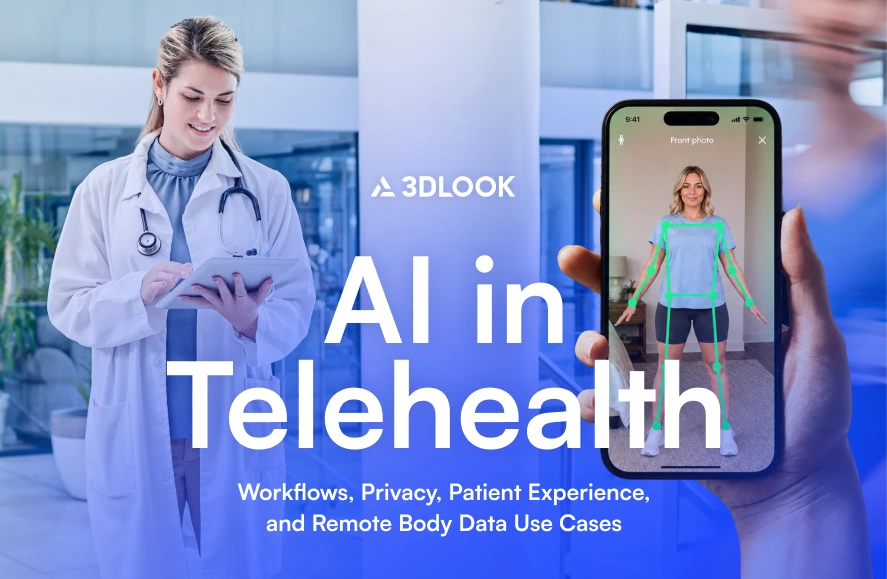
The platform guides the user through a simple two-photo capture flow and provides instant feedback to help improve scan quality and completion. - Receives results in under 45 seconds
3DLOOK processes the scan using its AI-powered computer vision system without manual review, delivering results quickly on any mobile device. - Gets structured scan results
The platform generates standardized body measurements, a 3D model, and progress data over time.
This approach enables a fast, scalable, mobile-first workflow that supports apparel, uniforms, wellness, fitness, and weight-loss use cases without specialized hardware or in-person scanning.
What 3DLOOK generates from two photos
3DLOOK turns a simple mobile capture into structured body data that can be used for various purposes depending on the use case. From a single scan, the platform generates:
- 3D body model
Visual body representation for progress comparison across scan sessions. - 80+ body measurements
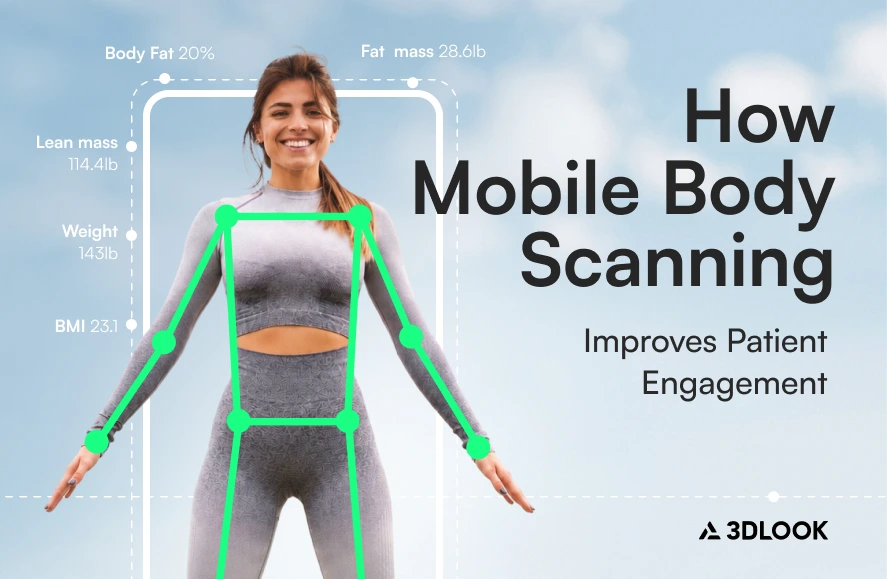
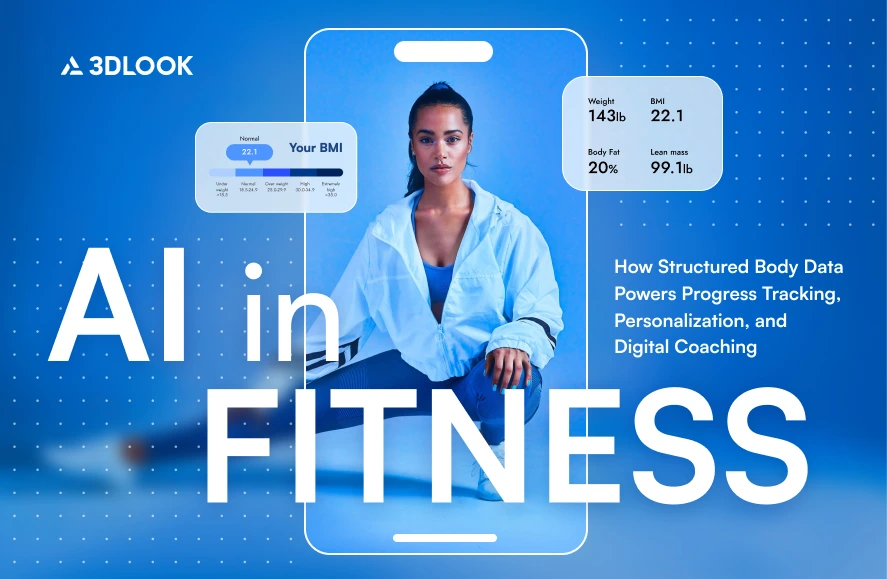
Waist, hip, chest, and 80+ key measurements for monitoring, review, and trend analysis. - Body composition outputs
Body fat %, lean and fat mass, BMI, BMR. - Body progress outputs
Scan-to-scan trends and comparisons for longitudinal tracking. - Smart Scales results
Cross-check self-reported inputs where relevant. - Future Body results
Visualizing how the body will look at the desired weight.
These outputs support multiple use cases. 3DLOOK’s FitXpress solution provides body composition outputs, body progress tracking, Smart Scales, and Future Body to support wellness, fitness, weight-loss and telehealth use cases, including engagement, progress monitoring, and longitudinal reporting. For apparel and uniforms, 3DLOOK delivers accurate body measurements that companies can use for custom-fit and specialized measurement workflows.
Discover how AI-powered body intelligence is reshaping GLP-1 programs, telehealth, and digital health, from accurate remote assessments to safer and more engaging patient journeys.
80+ body measurements
From two photos, 3DLOOK generates 80+ precise body measurements for monitoring, review, and trend analysis. These outputs include both circumference and linear measurements across the body and support use cases that require consistency, scale, and speed.
3DLOOK AI-driven 3D body-scanning solutions offer a personalized experience for tracking key body metrics and weight-loss progress to achieve health and wellness objectives. For apparel, uniforms, and custom-fit programs, 3DLOOK delivers the most commercially important outputs, such as chest, waist, and hips, which play a central role in custom-fit workflows and uniform measurement applications.
Body composition outputs
3DLOOK also generates body composition outputs that support wellness, fitness, and weight-loss workflows. These outputs include:
- BMI
- BMR
- Body fat %
- Fat body mass
- Lean body mass
These outputs give users and organizations a more complete picture than a single weight number alone. They support progress tracking, coaching programs, and body insight experiences where change over time matters.
For FitXpress and related health, wellness, fitness, and weight-loss use cases, these outputs make the product more actionable. Instead of relying solely on basic self-reporting, organizations can use structured body data to support engagement, progress measurement, and more personalized experiences.
Body progress outputs
3DLOOK’s outputs become even more powerful over time. Body progress tracking helps users and organizations monitor how measurements and body composition outputs change across repeated scans, which makes the technology especially useful for:
- Wellness and fitness programs
- Weight-loss journeys
- Health coaching
- Remote assessments
- Consumer body insight tools
Because the same guided mobile workflow can be repeated over time, progress becomes easier to track, communicate, and act on in real-world programs.
Smart Scales and Future Body
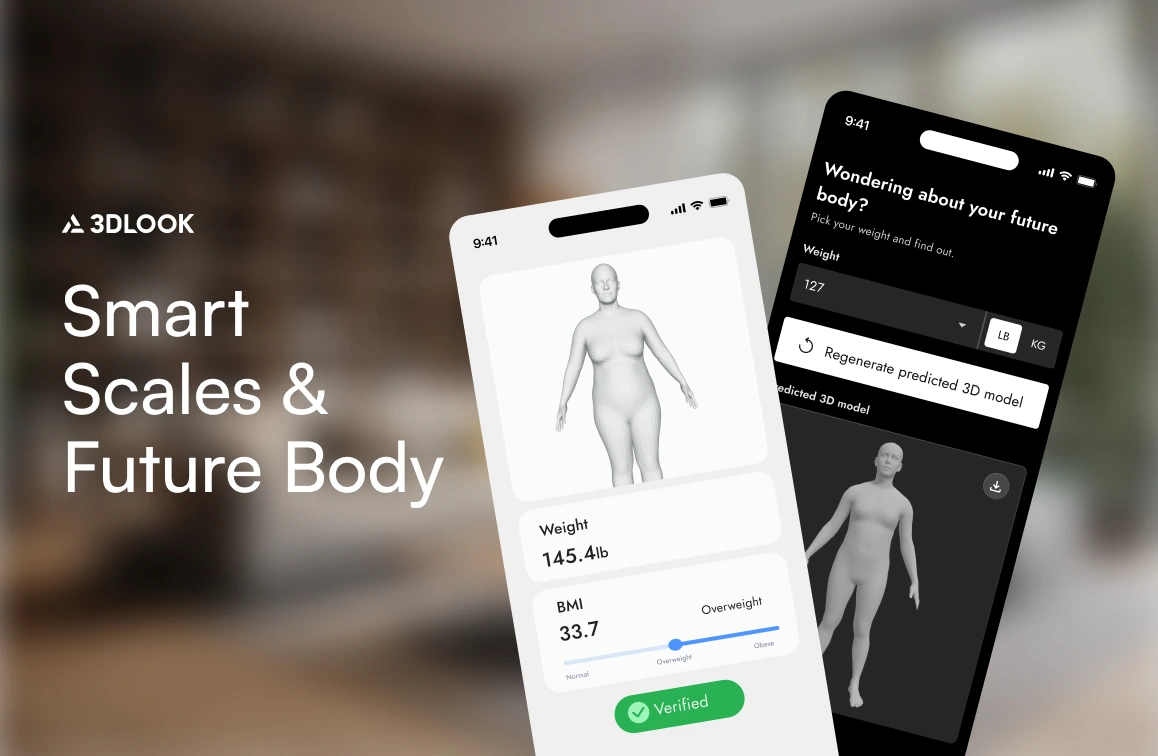
3DLOOK extends its core scan outputs through Smart Scales and Future Body.
Smart Scales predicts weight and BMI from two photos and can flag discrepancies between the entered weight and AI-predicted weight. That creates an additional layer of insight for wellness, fitness, and weight-related workflows.
Future Body uses two photos and a user’s desired weight to visualize what the user may look like at that target weight. This feature supports motivation, coaching, and user engagement by helping people connect body goals with a visual outcome.
Together, Smart Scales and Future Body demonstrate how 3DLOOK’s structured body data can support not only measurement but also progress, behavior change, and user engagement.
What inputs 3DLOOK uses
3DLOOK uses:
- Two photos
- Guided framing
- Supporting inputs such as height, weight, age, and gender.
Together, these inputs help the platform generate rich outputs from a simple mobile workflow. The goal is not just convenience but a scalable, repeatable way to turn everyday smartphone captures into usable body data.
Why 3DLOOK uses two photos instead of specialized hardware
Using two photos makes 3DLOOK more accessible, scalable, and easier to deploy across consumer and enterprise use cases.
A mobile-first workflow reduces the friction, cost, and complexity typically associated with specialized scanning equipment. It also makes adoption easier for remote users, distributed workforces, wellness programs, apparel brands, and uniform programs.
A key strength of 3DLOOK is its ability to deliver rich body data through a simple mobile capture experience, without requiring specialized hardware.
How easy it is to complete a 3DLOOK scan
3DLOOK is designed to make scanning fast and simple through a guided mobile experience that uses just two photos and delivers outputs in under 45 seconds. The workflow is built for real-world use, making it easier to achieve consistent results without specialized hardware or in-person scanning, and making the experience practical for repeat use across both consumer and enterprise settings.
How 3DLOOK outputs support different use cases
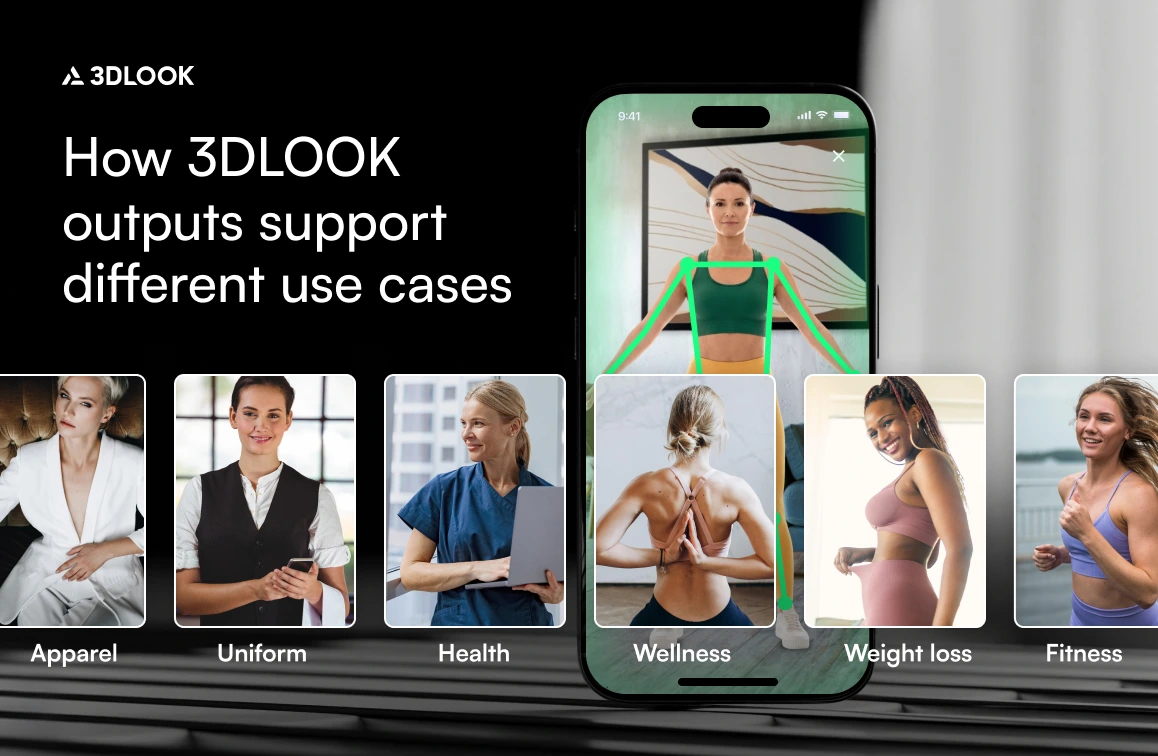
3DLOOK’s outputs are best understood by the use cases they support.
For apparel and uniforms, the platform provides accurate body measurements to support custom-fit workflows and uniform-measurement applications. In these workflows, chest, waist, and hips are often the most commercially important measurements. 3DLOOK’s body measurement system generates a 3D model in addition to over 80 circumference and linear measurements. For FitXpress, the platform supports health, wellness, fitness, and weight-loss experiences through body-composition and body-progress outputs, Smart Scales, and Future Body. This makes it easier for organizations to track progress, improve engagement, and build user experiences around clear body data rather than guesswork.
How accurate are 3DLOOK results?
Based on real-world customer scan events benchmarked against expert manual measurements, 3DLOOK has shown:
- approximately 96 to 97% accuracy compared with manual measurements across body metrics
- a typical error margin of 1.5 to 2.0 cm
- over 95% repeatability
- variance of less than 1 cm across repeated scans
These proof points make 3DLOOK especially valuable for organizations that need structured body data at scale with strong consistency across repeated scans.
How to talk about 3DLOOK outputs clearly
Customers should present 3DLOOK outputs in clear, practical language that helps end users understand what each result is, what it means, and what it helps them do. That may include improving apparel fit, tracking body progress over time, supporting wellness insights, or increasing engagement in fitness and weight-loss programs.
The strongest user experiences combine clear labels, practical explanations, and progress-oriented language. They connect each output to a real user benefit rather than to technical terminology.
For enterprise implementations, 3DLOOK outputs should be presented in terms of available outputs, required inputs, supported use cases, and confidence in consistency and repeatability, with the focus on business value and real-world application.
Across all implementations, 3DLOOK outputs are most effective when presented as structured body data that supports action, progress, and better user experiences. They should be positioned as supportive body data outputs rather than standalone diagnostic conclusions.
Conclusion
3DLOOK’s AI-powered body-scanning technology turns two photos into structured body data through a simple mobile workflow. With outputs including 80+ body measurements, body composition outputs, body progress tracking, Smart Scales, and Future Body, the platform supports a wide range of use cases across apparel, uniforms, wellness, fitness, and weight loss.
For organizations seeking to deliver scalable body data without specialized hardware, 3DLOOK offers a proven, differentiated solution. Want to see how 3DLOOK can support your use case? Book a demo to explore how FitXpress, Mobile Tailor, and 3DLOOK’s AI-powered body scanning solutions can work for your business.
FAQ
3DLOOK turns two photos and supporting inputs into structured body data using its patented, proprietary AI and computer vision system. Outputs include 80+ body measurements, body composition outputs, body progress outputs, and additional capabilities such as Smart Scales and Future Body.
3DLOOK is designed to make scanning fast and simple through a guided mobile experience that uses just two photos. The workflow is built for real-world use, making it easy to capture consistent results without specialized hardware or in-person scanning. Results are processed in under 45 seconds.
3DLOOK delivers 80+ precise body measurements from just two photos, covering both circumference and linear dimensions across the full body.
3DLOOK provides BMI, BMR, body fat percentage, fat body mass, and lean body mass. Our system also supports body progress tracking, predicts weight and BMI with our Smart Scales feature, and generates a Future Body visualization with our Future Body feature.
3DLOOK uses two photos, guided framing, and supporting inputs such as height, weight, age, and gender.
3DLOOK combines two photos, guided framing, and AI-powered computer vision in a patented, proprietary system that turns a simple mobile capture into structured body data. The technology validates image quality, pose, clothing, and capture context, then processes the images through advanced computer vision and body-data inference pipelines to generate rich outputs from a single scan. The result is a fast, scalable, mobile-first workflow that supports apparel, uniforms, wellness, fitness, and weight-loss use cases.
Using two photos makes 3DLOOK more accessible, scalable, and easier to deploy across consumer and enterprise use cases. It enables a mobile-first experience that delivers rich body data without the friction, cost, or complexity of specialized scanning equipment.
Smart Scales predicts weight and BMI from two photos and flags discrepancies between the entered weight and the AI-predicted weight.
Future Body uses two photos and a user’s desired weight to visualize how the user may look at that target weight.
3DLOOK generates a broad range of structured body data, including body measurements, body composition, and body progress tracking, but not visceral fat.
3DLOOK delivers accurate, repeatable results when scans are captured under the right conditions. Tight clothing, good photo quality, and a consistent guided capture flow help produce reliable body data across repeated scans, making the technology especially effective for body progress tracking, apparel fit, wellness, fitness, and weight-loss use cases.
3DLOOK outputs are intended to support wellness, fitness, weight loss, body progress tracking, and apparel fit. They should be positioned as supportive body data outputs rather than standalone diagnostic conclusions.
The best use cases for 3DLOOK’s body-scanning technology include apparel fit, uniforms, body progress tracking, wellness, fitness, weight loss, and broader body-insight applications. The technology can also support specialized measurement workflows where precision, consistency, repeatability, and fine-grained precision are essential.
3DLOOK outputs should be communicated in clear, practical language that explains what each result is, what it means, and how it can be used.
The SDK camera flow is intentionally standardized to support a consistent capture experience and reliable scan performance. Clients can brand the surrounding product experience, while the capture layer remains streamlined and guided.
The SDK tutorial itself is not customizable, but it can be launched with the tutorial disabled. In that case, you can build and present your own instructional flow before entering the SDK capture experience.
In the RTPV (real-time pose validation) flow, user guidance happens during capture through real-time instructions. Separate backend validation messages are not shown to the user in that mode, since RTPV serves as the validation layer itself. When RTPV is enabled, backend validation is disabled. As a result, there is no separate set of rejection/error messages in the capture flow to override. We strongly recommend that you do not disable RTPV.
The SDK handles photo capture only. After capture, your backend is responsible for sending images to the API and handling the returned outputs.