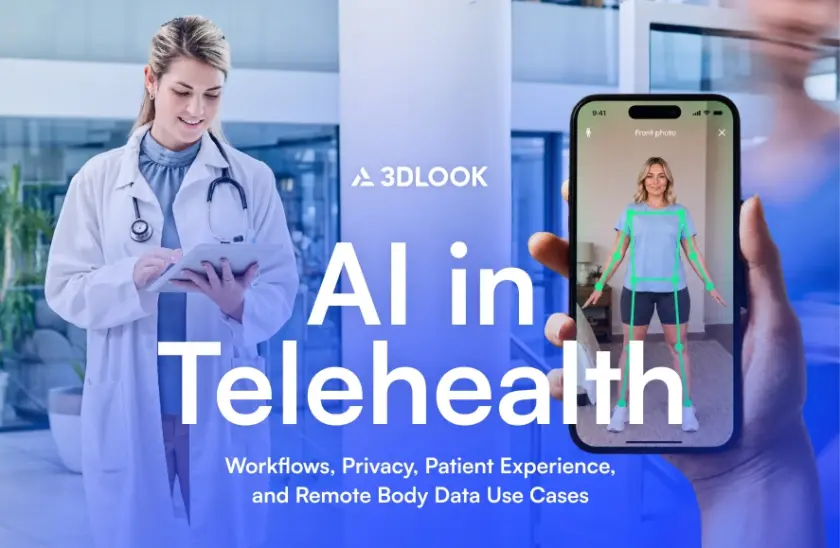
What is AI in telehealth?
AI in telehealth supports work that happens before, during, and between virtual consultations. That work runs from patient intake and documentation to remote monitoring and follow-up. As remote programs grow, the challenge is not simply collecting more information. It captures information consistently, integrates it into existing workflows, protects sensitive data, and ensures that qualified professionals are responsible for clinical decisions.
Body measurements are one area where remote workflows can lose consistency. Patients may use different equipment, follow different measurement techniques, or report information in incompatible formats. Structured mobile capture can help create a more comparable record for provider review.
A useful way to frame AI in telehealth is in operational rather than clinical terms. The question is not whether software can diagnose. The more useful question is where AI and structured body data can support a remote-care workflow while qualified professionals remain responsible for clinical decisions. That question matters most to care teams, clinical operations leads, chief medical officers, and heads of member engagement at remote-first health organizations.
Scope note. FitXpress is a mobile body-scanning and structured-data-capture layer that supports clinician review. It does not diagnose, make treatment decisions, or determine eligibility. FitXpress is not positioned as a medical device, and clinical judgment stays with the care team throughout.
Where AI fits in remote-care workflows
Remote care runs on a sequence of steps that repeat for every patient: intake, monitoring between visits, the consultation itself, documentation, and follow-up. AI supports several of these steps without owning the clinical decision at any of them.
At intake, AI-supported body-data capture and symptom tools help organize a patient’s reports into a consistent format before a clinician reviews them. Between visits, remote monitoring surfaces readings from connected devices, allowing a care team to track changes without an in-person appointment. During and after the consultation, documentation tools help draft notes, so staff spend less time on manual write-ups. In each case, the software organizes or surfaces information, and a qualified professional interprets it.
Higher remote volume raises the cost of inconsistent intake. As programs transition from hundreds to thousands of remote check-ins, comparing manually collected and self-reported data across the patient population becomes more difficult. Standardized capture and clear documentation can help remote-monitoring workflows scale while maintaining a more consistent basis for review.
That is the practical reason structured body data matters in remote care. It supplements manually entered body data with a more standardized capture record for provider review and verification. Remote patient monitoring (RPM) relies on the same principle: data captured between visits is only useful when it stays comparable across time.
Common AI-supported use cases
AI shows up across telehealth in a handful of recognizable categories.
Remote patient monitoring. Connected devices capture readings between visits and pass structured data to the care team. The KardiaMobile device from AliveCor, a portable electrocardiogram (ECG) recorder, enables patients to record heart activity at home for provider review. Depending on the product and configuration, accompanying software may analyze the recording and surface findings for the reviewing clinician.
Virtual triage and health assistants. Symptom-assessment tools such as Ada guide users through structured questions to help them assess their symptoms and consider appropriate next steps. Such tools can organize symptom information before a consultation.
AI-assisted imaging prioritization. In telehealth and distributed-care networks, AI can flag imaging studies with suspected time-sensitive findings for earlier review. This helps remote clinical teams organize high-volume worklists and direct attention to potentially urgent cases.
AI-supported analysis and personalized feedback. AI can analyze remotely collected health data — such as activity, vital signs, and other patient-generated information — to identify patterns and support more personalized feedback. This can give patients and care teams additional context for remote check-ins, although the usefulness of the insights depends on data quality, appropriate validation, and professional interpretation (Scientific Reports).
Conversational behavioral support. Conversational agents can support patients between telehealth appointments through health education, structured check-ins, feedback, monitoring, and guided self-management activities. These tools can provide support available outside scheduled consultations, but their effectiveness varies by intervention, and they should complement rather than replace professional care.
Documentation automation. Ambient documentation services, such as Augmedix, draft clinical notes from a visit, helping reduce the time staff spend writing them up. The output is a draft that the clinician confirms.
The remote body-data gap
Weight and body measurements are among the least consistent inputs in remote care. A patient may use a bathroom scale, take measurements with a cloth tape, or provide an estimate. In the next session, the equipment, technique, or reporting format changes. The result is a record that appears to be data but does not compare cleanly across time.
Self-reported measurements can vary due to the patient’s equipment, technique, recall, and reporting format, making longitudinal comparisons more challenging. A connected scale improves on a self-reported number, yet a scale still returns a single figure. It does not describe body shape or estimated composition, which is often what a program wants to track as a patient changes.
For longitudinal programs, comparability is essential. A measurement taken today is more useful when it can be compared with the same measurement from an earlier session under reasonably consistent capture conditions. When capture conditions drift, it becomes difficult to separate real change from measurement noise. Structured capture can improve comparability by reducing variation in how measurements are collected and formatted.
This is where mobile body scanning for telehealth enters the workflow: as a means to help standardize the capture step.
How mobile body scanning fits into telehealth
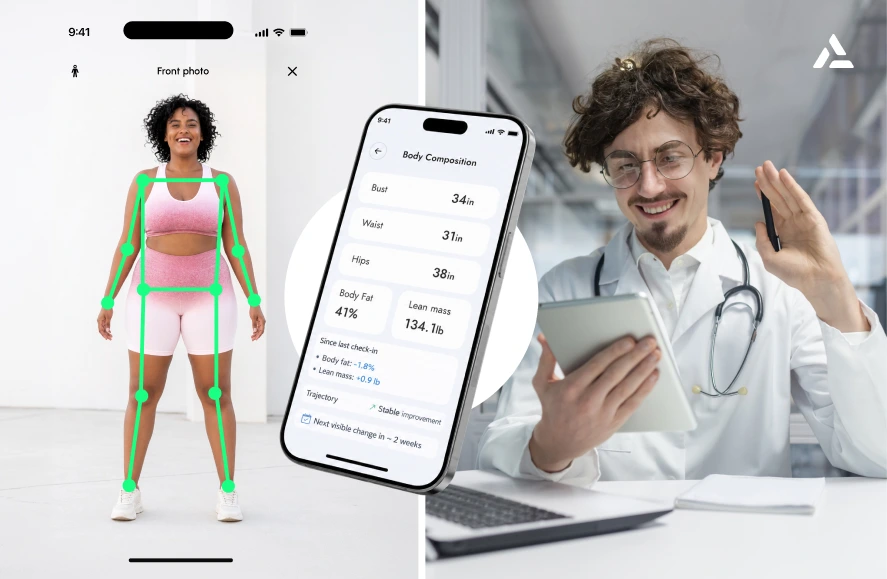
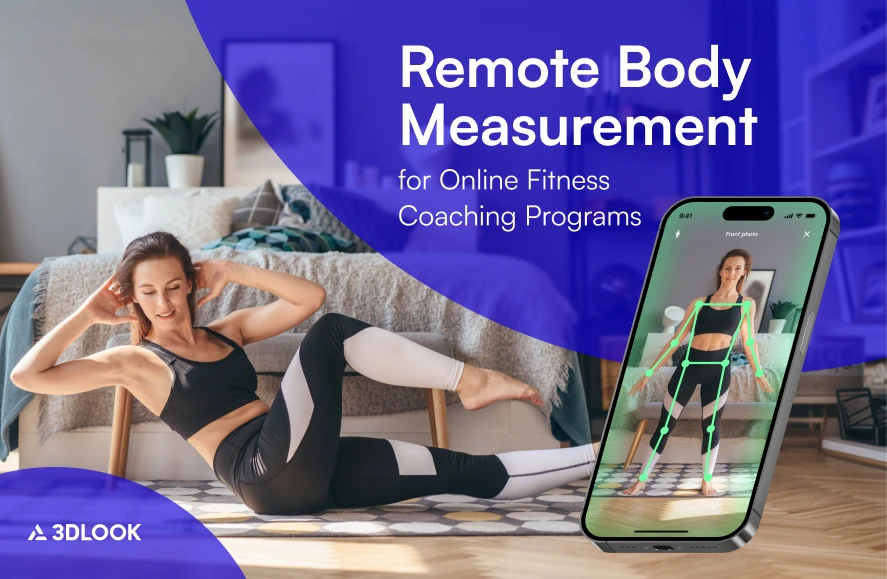
FitXpress captures body data from two smartphone photos, a front image and a side image. The full pipeline returns results in under 45 seconds. FitXpress uses the two photos, along with required onboarding inputs such as gender and height, to return more than 80 body measurements and a set of predicted or calculated outputs. These can include predicted weight, body mass index (BMI) calculated from the predicted weight and supplied height, basal metabolic rate (BMR), estimated body fat percentage, lean mass, and fat mass. No specialized hardware is required.
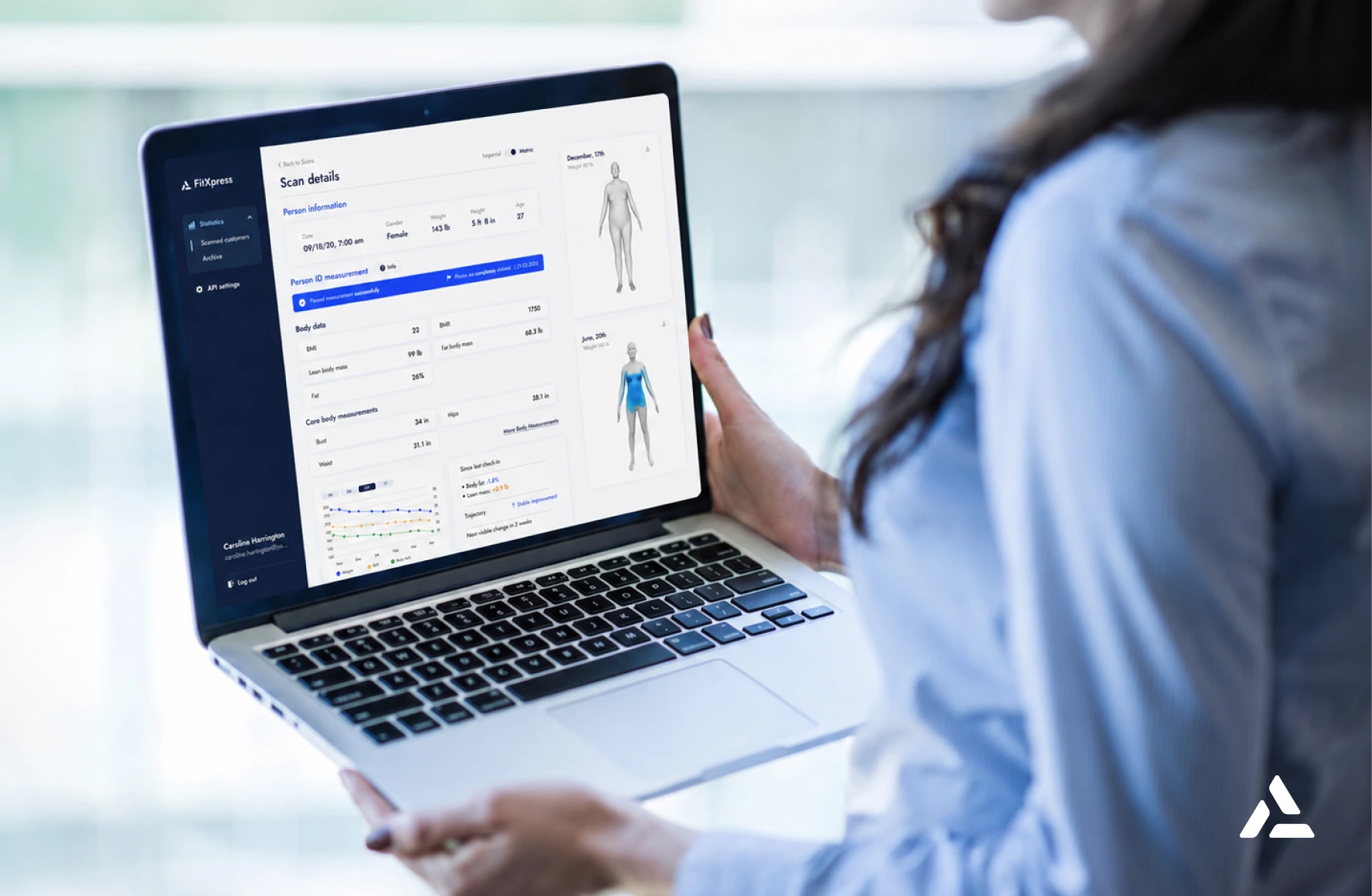
FitXpress processes the scan and returns structured outputs. Results are delivered through the application programming interface (API) to the customer’s existing interface and can be accessed through the FitXpress Admin Panel.
Positioned correctly, this is a structured data capture and remote intake layer. It helps standardize how body measurements are captured and returned for review. Reference methods keep their role wherever a protocol or clinical decision requires them, and FitXpress helps standardize the remote capture step around them rather than replacing a dual-energy X-ray absorptiometry (DEXA) scan or a calibrated clinical scale.
Repeatability is particularly important for longitudinal remote use. For most evaluated measurements, repeated scans showed typical scan-to-scan differences of less than 1 cm. Accuracy is a separate question, measured against a reference method under a defined protocol, and it should not be reduced to a single universal figure. For details on the accuracy figures, their reference methods, and the decisions they can support, see Body Scanning Accuracy: A Framework for Enterprise Decisions.
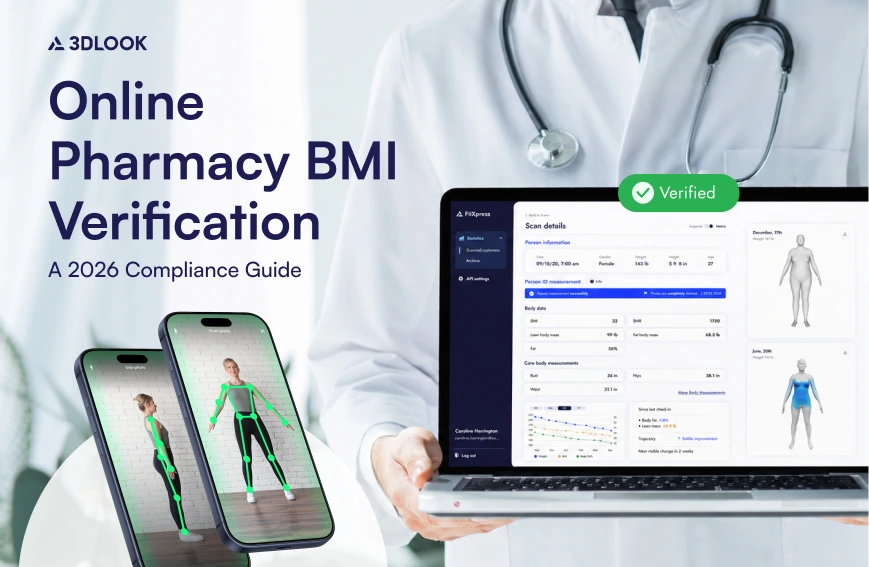
Within a telehealth program, the capture step fits into a workflow most teams already use: intake, processing, structured data delivery, provider review, documentation, and follow-up. The patient completes a guided two-photo scan at intake. FitXpress processes it and returns the structured outputs. A provider reviews the data, and the results can then be documented in accordance with the program’s workflow.
Weight-management telehealth is one of several use cases. Longitudinal monitoring and member-engagement programs can apply the same structured capture step to different workflows and objectives. For a closer look at how two photos become structured body data, see Two Photos → Structured Body Data.
Patient-experience considerations
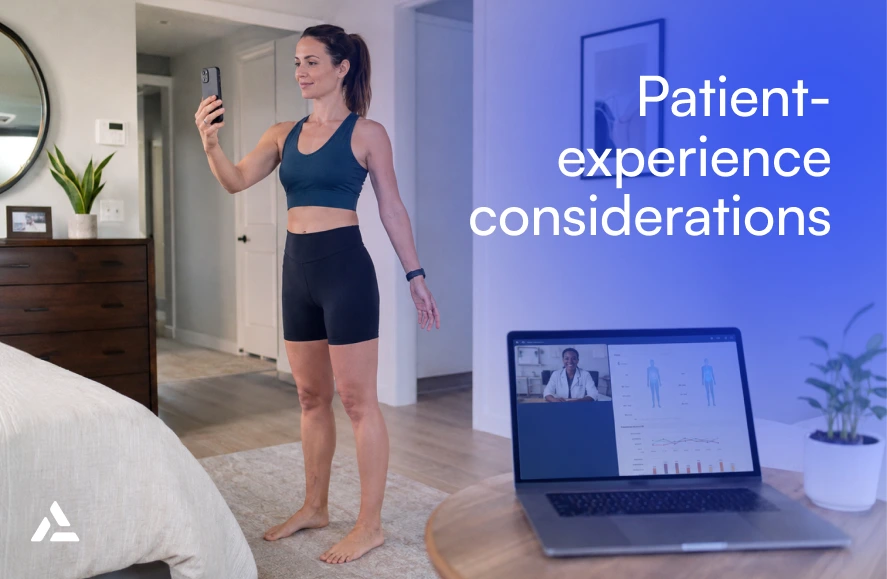
A remote scan can reduce the need for a separate in-person measurement appointment in workflows where remote capture is appropriate. That convenience only helps if the capture experience is clear and the patient is comfortable with it.
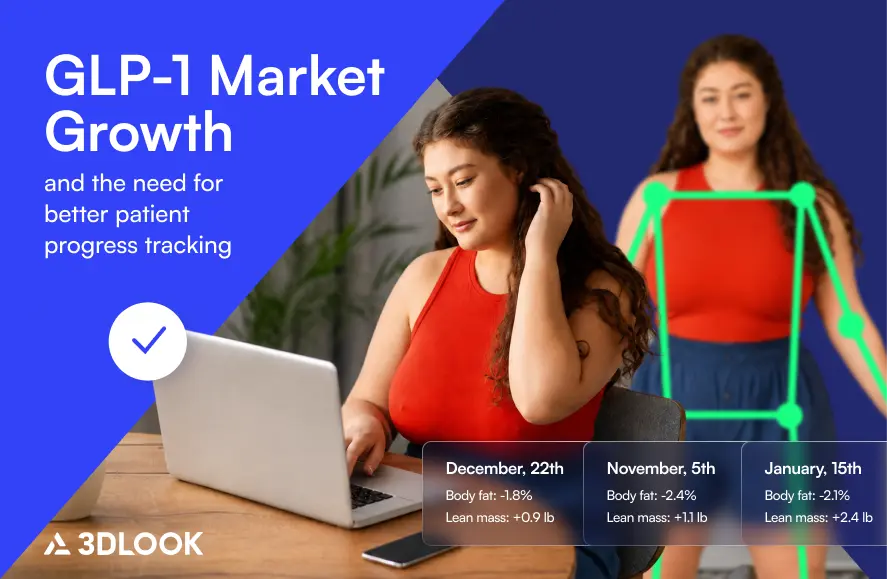
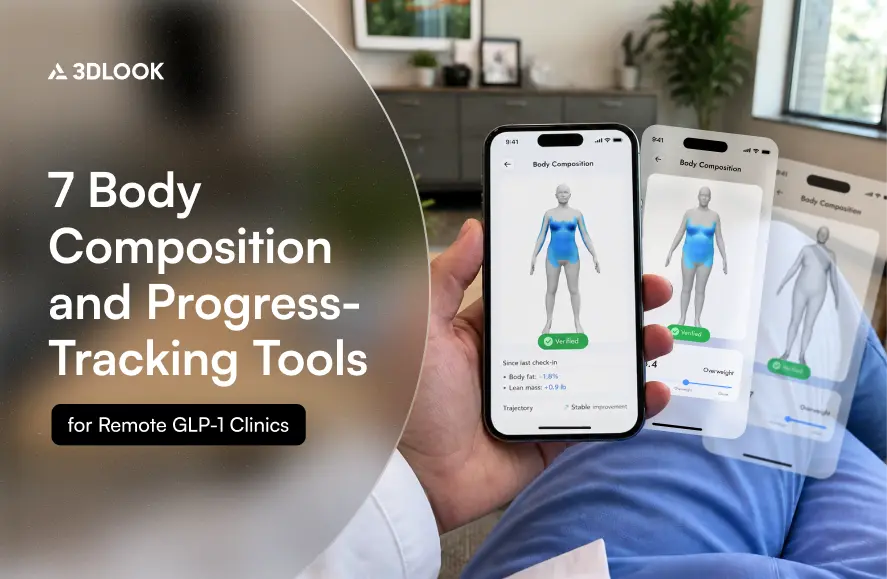
Progress views can provide patients and care teams with a new angle to discuss changes between visits, particularly when scale weight alone does not reflect changes in body shape or estimated composition.
A few practical considerations shape whether patients complete a scan and trust it.
Why are the photos needed, and what consent is required? A patient should understand that the scan uses two photos, a front and a side image, to generate measurements. The images are processed to generate the body model, measurements, body composition, and associated outputs. The patient-facing explanation and consent process should address what will be captured, why it is needed, how it will be used, and how long it will be retained, in accordance with the organization’s applicable requirements. This explanation should be included in the patient-facing flow, where patients can access it when needed. A policy document alone is unlikely to provide sufficient visibility.
Comfort with image capture. Body photos are sensitive. Some patients will hesitate, so a program should be ready to explain privacy handling in plain terms before the capture step rather than after.
Clear capture instructions. Results depend on consistent pose, clothing, and lighting. Guided, specific instructions help patients get a usable scan on the first try and reduce variation between sessions.
Accessibility and device limits. Not every patient has a recent phone, a private space, or the mobility to stand for a scan. A program should plan for these limits rather than assume every patient can complete the flow the same way.
Retakes and failed captures. Some scans may require another attempt. The flow should provide clear, supportive guidance on the next steps, helping patients complete the capture successfully and continue through the process.
An alternative path. A patient who cannot, or prefers not to, scan needs another way to remain in the program. The scan should be one supported route, not the only one.
Understanding the outputs. Patients and staff should receive clear guidance on the type, basis, and appropriate interpretation of each output.
Who can see the outputs? It should be clear who has access to a patient’s results. The provider, patient, and platform administrator may each see different views, and setting that expectation early supports trust.
Privacy, security, and data governance
Privacy, security, and documentation requirements are central to evaluating technology for telehealth workflows. FitXpress supports Health Insurance Portability and Accountability Act (HIPAA)-compliant implementations, including a Business Associate Agreement (BAA) on request, and General Data Protection Regulation (GDPR)-aligned workflows. The compliance framework focuses on data privacy and workflow implementation. The technology can support a compliant workflow, while responsibility for the overall compliance outcome remains with the program operator.
Data handling is built around minimization. Photos are deleted after processing by default. Any alternative retention arrangement is defined in the contract in accordance with the customer’s approved workflow and applicable requirements. 3DLOOK does not require names or direct personal identifiers to process a FitXpress scan. Customers control how session identifiers are associated with patient records in their own systems. Data is encrypted in transit and at rest.
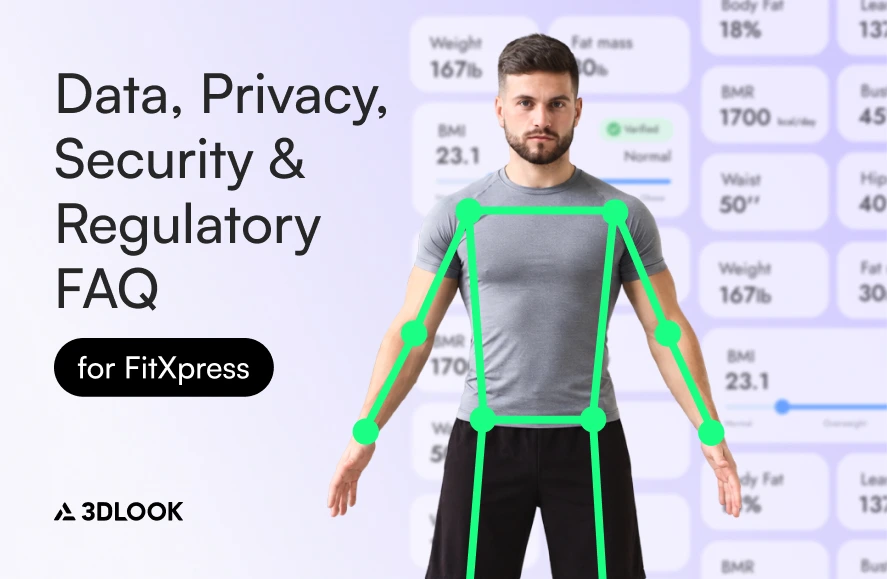
For FitXpress-specific information on data handling, retention, security controls, and regulatory status, see the FitXpress data, privacy, security, and regulatory FAQ. For current legal and data-handling terms, see the 3DLOOK legal center.

FitXpress capabilities and boundaries
FitXpress works as an operational layer. It captures structured body data from two smartphone photos and returns it for review, reducing the need to collect the same measurements manually in workflows where remote scanning is appropriate. Clear boundaries define its appropriate role within the workflow.
Four boundaries define what FitXpress does not do in a telehealth workflow:
- It does not diagnose or determine treatment. Clinical judgment and treatment decisions stay with the care team. FitXpress supports that review with structured data.
- It does not autonomously triage or determine eligibility. Routing and eligibility decisions remain with the customer’s responsible professionals and established workflow. FitXpress provides input, and the decision stays with the professional.
- It does not replace protocol-required assessment methods. Where a protocol calls for DEXA, a calibrated scale, or another reference method, that method keeps its role. FitXpress helps to standardize the remote capture step around it.
- It does not, on its own, make the customer’s workflow compliant. Compliance is a programmatic outcome that the organization owns. FitXpress supports compliant workflows.
How to evaluate an AI tool for telehealth
Before adopting an AI tool for a remote-care program, the useful first question is not “how accurate is it?” but “accurate enough for which decision?” A tool that supports progress tracking faces a different bar than one that feeds a clinical determination. A short checklist keeps the evaluation grounded.
- Does it diagnose, or does it capture data? A capture-and-documentation tool and a diagnostic tool carry very different regulatory and clinical weight. Be clear which one you are buying, and confirm the vendor positions it the same way.
- Does it integrate with existing systems? Structured output has value only if it reaches the record a clinician actually reviews. Check whether results arrive through an API into your interface, through a vendor console, or through a manual step that adds work.
- Is the output structured or free-text? Structured, consistently formatted output supports comparison across time and cleaner internal review. Free-text or screenshot output is harder to track longitudinally.
- What is the privacy and retention posture? Confirm how images and derived data are handled: what is deleted, what is retained, on what basis, and under what agreement. For sensitive body data, ask about encryption in transit and at rest, identifier handling, and whether a BAA is available.
- How is accuracy qualified? Treat any single accuracy number with caution. Ask against which reference method, under which capture protocol, for which population, and at what tolerance the figure holds. Repeatability and accuracy are separate properties, and a vendor should be able to explain both.
Discover how AI-powered body intelligence is reshaping GLP-1 programs, telehealth, and digital health, from accurate remote assessments to safer and more engaging patient journeys.
Related resources
- Understand the technology. See how two photos become structured body data in Two Photos → Structured Body Data.
- Evaluate the evidence. Learn how reference methods, test populations, and capture conditions affect the interpretation of body-scanning results in our body-scanning accuracy framework.
- Explore a specific workflow. For remote prescribing and BMI checks, see the online pharmacy BMI verification guide.
- Assess product fit. Review how structured body-data capture supports remote programs on our Telehealth & Digital Health page.
- Review policies. Read the current terms and data-handling policies in the 3DLOOK legal center.
To see how structured body-data capture could fit your remote-care workflow, explore FitXpress for Telehealth & Digital Health or book a demo with our team.
Disclaimer. FitXpress is a mobile body-scanning and structured-data-capture solution that supports clinician review. It is not positioned as a medical device. It does not diagnose or treat, and clinical, triage, and eligibility decisions stay with the care team.
FAQ
AI in telehealth is the use of machine learning and computer vision tools to support remote care workflows: intake, monitoring, triage support, documentation, and structured data capture. These tools organize and surface information for the care team, and clinical decisions stay with clinicians.
It fits at the capture step of a flow most programs already run: intake, processing, structured-data delivery, provider review, documentation, and follow-up. The patient completes a guided two-photo scan, and FitXpress returns structured outputs. Results are delivered to the care team via the API and the FitXpress Admin Panel for clinician review.
No. Mobile body scanning supports clinician review and helps standardize remote capture. It does not replace a DEXA scan or an in-clinic assessment where a protocol or clinical decision requires those methods. Its strongest role is supporting more standardized, repeatable capture between clinical assessment points.
From two smartphone photos and onboarding inputs such as gender and height, FitXpress returns more than 80 body measurements and a set of predicted or calculated outputs, including predicted weight, BMI calculated from predicted weight and supplied height, BMR, estimated body-fat percentage, lean mass, and fat mass, with results in under 45 seconds. No specialized hardware is required.
FitXpress supports HIPAA-compliant implementations, including a BAA on request, as well as GDPR-aligned workflows. Organizations remain responsible for assessing and managing compliance across their complete implementation, including consent, data association, access controls, retention, and internal use.
No. FitXpress is a structured data capture layer that supports clinician review. Clinical, triage, and eligibility decisions stay with the care team and the responsible parties.
Longitudinal monitoring programs, member engagement programs, and remote weight management programs are common fits.
Self-reported measurements can vary with the patient’s equipment, technique, recall, and reporting format. Mobile body scanning uses a guided capture process to return body measurements in a consistent format. For most evaluated measurements, repeated scans showed typical scan-to-scan differences of less than 1 cm. Predicted weight, BMI, and other predicted or calculated outputs should be interpreted in light of the validation evidence specific to those outputs.