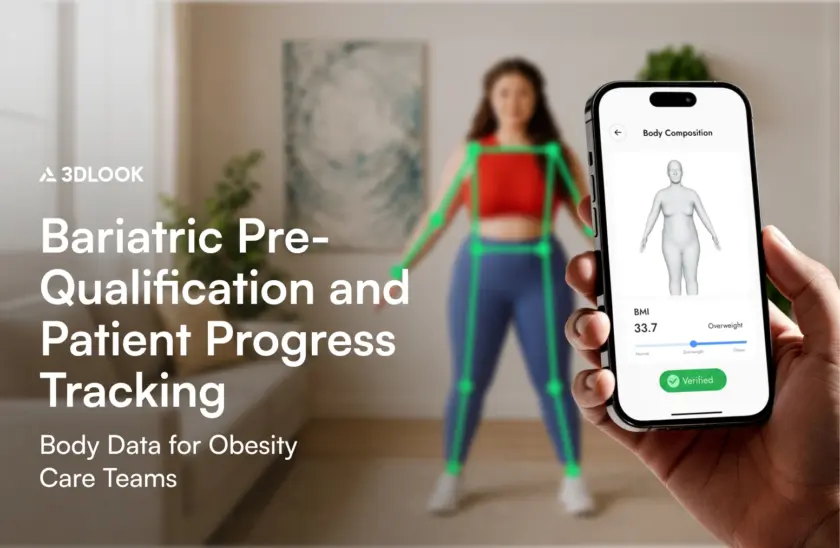
Bariatric programs need body metrics at two distinct points: before clinical review begins and during follow-up after treatment. When the first usable record appears only at the consultation, staff may need additional outreach before they can complete pre-qualification or prepare a prior-authorization packet. Mobile 3D body scanning changes that sequence by making dated, consistently formatted body data available earlier.
The record serves two purposes: early intake review and a baseline for later comparison. Clinical eligibility and treatment decisions remain with the care team, while each payer decides whether submitted documentation meets its requirements.
Use Case Summary
| Industry | Bariatric surgery centers, hospital bariatric programs, multi-site surgical networks, metabolic clinics, and obesity-care programs |
| Problem | Pre-qualification inputs captured late, consultation time used for initial measurement, and body-data records that vary in format or traceability |
| Solution | A guided two-photo remote scan is completed before the consultation, returning a structured body-data record to the program |
| Outputs | Predicted weight from Smart Scales, BMI comparison values, 80+ body measurements, body composition estimates, a capture timestamp, and capture-quality checks and flags |
| Role | Provides body-metric inputs and discrepancy signals for human review; clinical eligibility and payer acceptance are decided outside the software |
| Business value | Earlier body-data availability and more standardized records; pilot measures may include intake completion, time to a completed record, prior-authorization rework, measurement-only appointments, and follow-up completion |
What changes when body data are available before the consultation?
The potential patient population is large, but only a small share of eligible patients undergo bariatric surgery. The most recent clinical measurement cycle from the Centers for Disease Control and Prevention (CDC), conducted from August 2021 to August 2023. It found that 40.3% of US adults had obesity (BMI of 30 or higher) and 9.4% had severe obesity (BMI of 40 or higher). The American Society for Metabolic and Bariatric Surgery (ASMBS) states that less than 1% of eligible patients undergo surgery in a given year.
Preoperative attrition also varies by program design and study definition. A 2026 narrative review identified reported attrition rates as high as 60%, while other cohorts in the reviewed literature reported substantially different rates. An earlier capture will not resolve every barrier. It does give each program a defined point at which to measure whether patients complete intake and how quickly a usable record reaches the review team.
In this setting, pre-qualification means an intake review of preliminary alignment with program criteria and known payer requirements before a full clinical evaluation. A patient progress record is a dated series of comparable body metrics collected before and after the procedure.
The word structured is important. Each capture follows the same guided sequence, returns machine-readable fields, and includes a timestamp. When capture instructions are followed and quality checks pass, reviewers can compare records collected at defined time points. Implementation details for home capture, positioning, clothing, and fallback workflows are covered in the FitXpress capture-quality FAQ.
That consistency is useful when intake begins with self-reported information. CDC researchers reported in Preventing Chronic Disease that self-reported BMI underestimated the population prevalence of severe obesity by 40%, with a prevalence of 5.3% based on self-reports and 8.8% after bias correction in 2020 data. This population-level result does not establish whether an individual patient’s information is accurate. It does support a workflow that records the source of each value and routes discrepancies for review.
Remote capture supplies inputs, not conclusions. Clinical teams and payers retain responsibility for their respective decisions. Related healthcare applications are covered in the AI body data across health programs.

Discover how AI-powered body intelligence is reshaping GLP-1 programs, telehealth, and digital health, from accurate remote assessments to safer and more engaging patient journeys.
Remote body measurement for bariatric patient intake
The following workflow places the first body-data capture after the intake questionnaire and before the consultation.
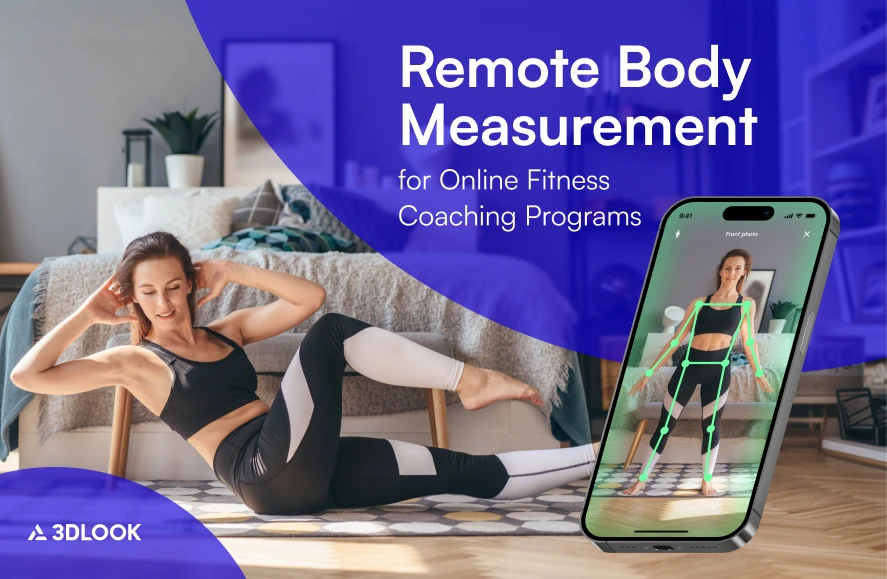
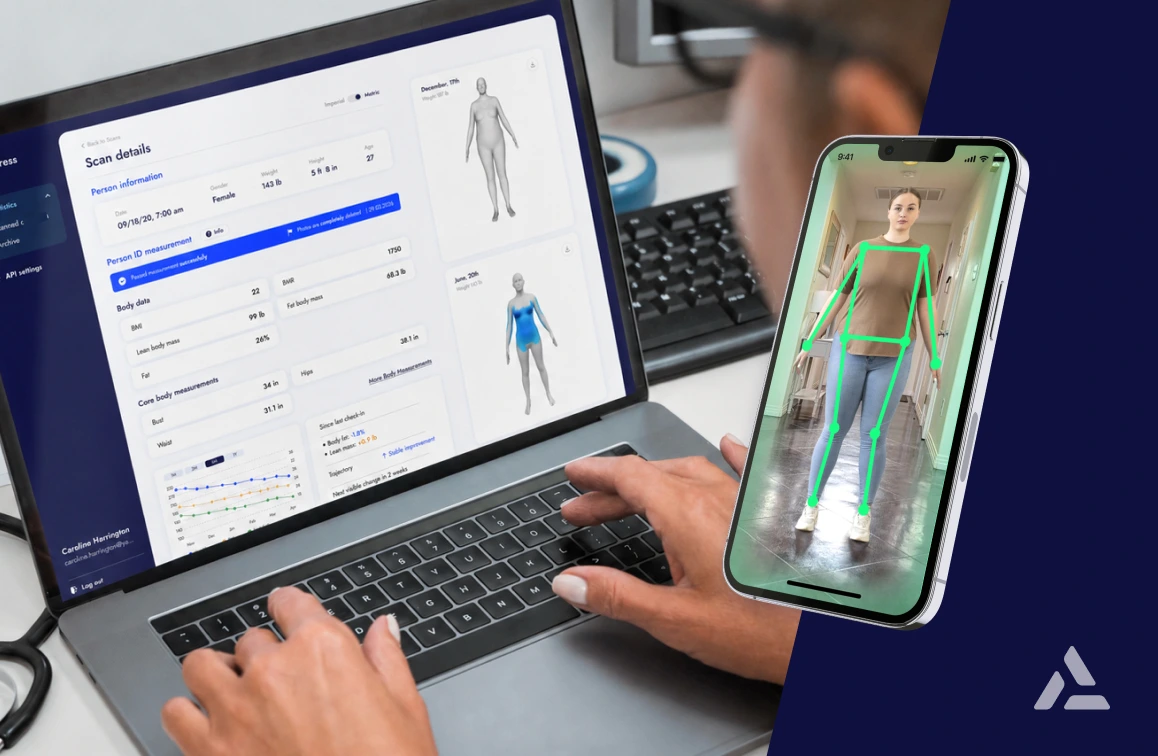
- Stage 1. Remote capture. The program sends a scan link. The patient completes guided front and side photo capture on a smartphone. FitXpress returns body measurements, body composition estimates, and predicted weight through the Smart Scales feature. If the program collects self-reported weight, it can compare the BMI calculated from self-reported height and weight with the BMI calculated from the same height and predicted weight from Smart Scales. A difference above the configured threshold is routed for human review.
- Stage 2. Pre-consult review. A coordinator checks that the record is complete and then sends it for authorized clinical review in accordance with the program’s intake criteria. Real-time pose validation guides the capture, while clothing-related flags are stored with the session. A patient whose capture does not meet the program’s requirements can repeat it or complete an in-clinic measurement. BMI values and capture-quality checks are available through BMI verification.
- Stage 3. Clinical consultation. The consultation can focus on medical history, comorbidities, surgical risk, and patient education because the body metrics are already in the record. The same intake pattern can support a hybrid schedule that combines virtual check-ins with in-person visits.
- Stage 4. Documentation preparation. The prior-authorization coordinator has access to the record before assembling the packet. A pilot can test whether this earlier access changes completion time, rework, or follow-up requests.
A single record may contain a capture timestamp, selected body measurements, two BMI values for comparison, and any quality flags. The software flags the discrepancy. The bariatric program decides whether the patient needs a retake, an in-clinic measurement, or further review.
Bariatric pre-qualification and prior-authorization documentation
Scope. The regulatory examples below concern US adult bariatric programs. Applicable laws, payer policies, and clinical protocols govern requirements in other jurisdictions and adolescent programs.
Under CMS-0057-F from the Centers for Medicare & Medicaid Services (CMS), new prior-authorization timeframes take effect on January 1, 2026. They cover Medicare Advantage organizations and specified Medicaid and Children’s Health Insurance Program (CHIP) payers. These payers must issue standard non-drug decisions within 7 calendar days and expedited decisions within 72 hours, subject to applicable extension provisions. The rule also requires specific denial reasons and public reporting of aggregated prior-authorization metrics. Its decision-timeframe provisions did not change the requirements for Qualified Health Plans on Federally Facilitated Exchanges and do not apply to Medicare fee-for-service. Commercial arrangements are not covered uniformly. Compliance counsel should interpret the rule alongside the relevant plan contract.
Bariatric documentation requirements vary by plan. A packet may include BMI history, comorbidities, previous weight-management attempts, participation in a supervised program, psychological evaluation outcomes, and other clinical records. When a policy calls for body-data documentation, the record may need a dated BMI, the height and weight used to calculate it, the source of those values, and the date or method of capture. The plan determines the final list and accepted sources.
A structured scan standardizes some of these fields and makes them available before submission. It does not alter a payer’s deadline or assure acceptance. The practical question is whether the first packet contains a more complete, traceable body-data record and requires fewer corrections. The online pharmacy BMI-verification compliance guide covers related controls used in remote BMI-verification workflows, including live capture and pose validation.
How does prior GLP-1 treatment affect BMI documentation at bariatric intake?
A JAMA Surgery study examined an insured claims cohort of 11.7 million adults. Between 2022 and 2024, metabolic bariatric surgery use fell 34.1% while glucagon-like peptide-1 (GLP-1) receptor agonist use rose 140.4% (JAMA Surgery, May 13, 2026). The GLP-1 market analysis covers coverage economics, prescribing growth, and drug-class comparisons.
An ASMBS release published May 5, 2026 reported a conference study of more than 6,700 patients who had used GLP-1 medications before bariatric surgery. On average, these patients lost approximately 8% of total body weight before the procedure.
A patient may therefore arrive at bariatric intake with a current BMI below an earlier documented value. The earlier BMI may or may not matter under the applicable program criteria and payer policy. Relevant details include the threshold, time period, and accepted documentation source.
For the intake team, the immediate task is to identify which metrics exist, when each was produced, and how its source is recorded. Starting the body-data record earlier in the obesity-care pathway provides a longer longitudinal baseline than starting it at the surgical consultation. A structured scan can preserve the capture time, source, and quality checks at each point; the plan still decides whether those fields satisfy a documentation requirement.
Patient progress tracking before and after surgery
The pre-surgery capture can become the baseline for later comparison. A postoperative scan follows the same guided sequence and returns the same field structure, making changes easier to review across defined time points.
Weight, circumference measurements, and body composition estimates describe different aspects of postoperative change. When the care team deems them appropriate, these values can be reviewed alongside medication history and other follow-up information.
Postoperative care may also include anti-obesity medication. Johns Hopkins researchers reporting on a JAMA Surgery analysis found that roughly one in seven bariatric surgery patients used new weight-loss drugs after surgery. Serial scans can place body data trends alongside that medication history. Related remote follow-up workflows are covered in the AI in telehealth section.
The resulting progress record is a dated series of selected metrics, not a clinical interpretation. The program sets the monitoring cadence, determines which fields to retain, and selects the record-keeping method for each clinical purpose.
Where FitXpress fits: outputs, accuracy, and limitations
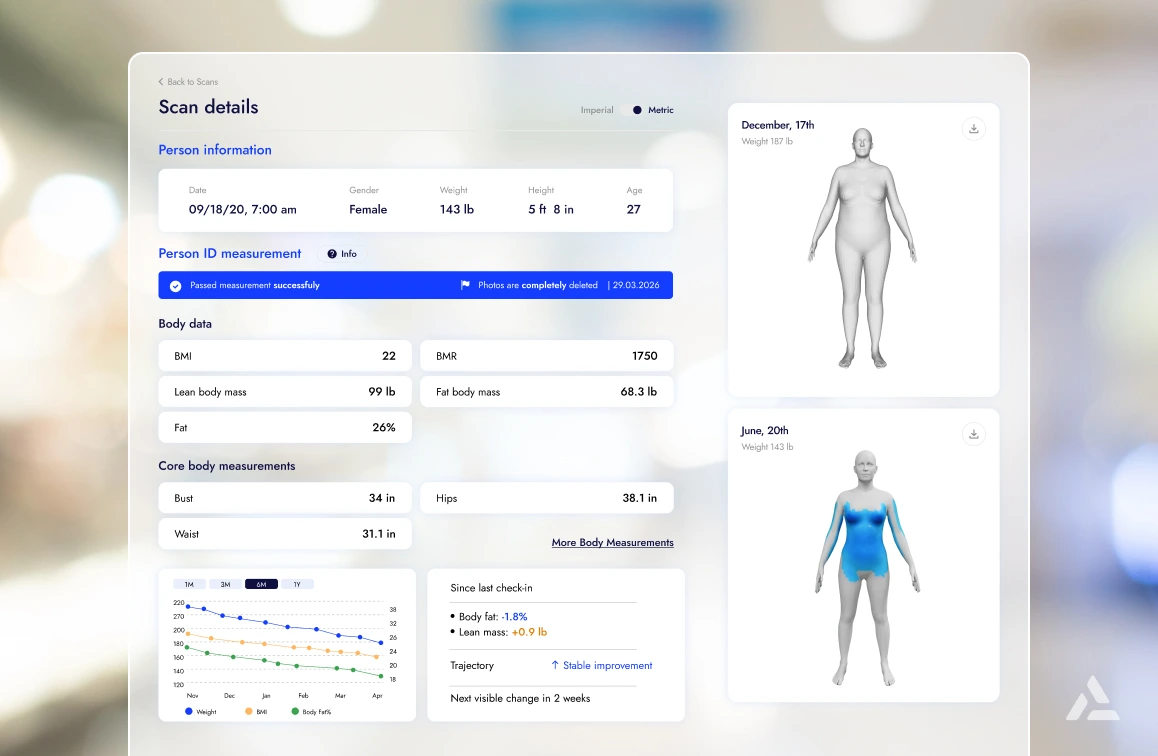
FitXpress by 3DLOOK is a mobile body-scanning solution built around guided front and side photos captured on a patient’s smartphone. It requires no specialized hardware. Results typically return in under 45 seconds and may include:
- a 3D model;
- 80+ body measurements;
- predicted weight from Smart Scales;
- calculated BMI and basal metabolic rate (BMR); and
- body composition estimates, including body fat percentage, lean mass, and fat mass.
Internal validation compared scans with expert pattern-maker manual measurements. Across the evaluated body measurements, reported accuracy was approximately 96-97%, with a typical absolute error of 1.5-2.0 cm per measurement, varying by body part. For most evaluated measurements, repeated scans showed typical scan-to-scan differences of less than 1 cm. The mobile body-scanning accuracy framework explains the reference method, capture conditions, and limits that give meaning to the accuracy figure.
In internal testing, the predicted weight from Smart Scales showed an average prediction error of approximately 3.5% relative to the scale weight. That figure is an average across evaluated captures, not the maximum error for an individual result. A flagged discrepancy between self-reported and predicted values warrants human review. It is not an automated eligibility conclusion.
FitXpress does not diagnose conditions, make clinical decisions, or determine treatment eligibility. Prior-authorization decisions remain with payers. FitXpress does not guarantee regulatory compliance, payer acceptance, or approval. It does not replace dual-energy X-ray absorptiometry (DXA), bioelectrical impedance analysis, or a calibrated scale where those methods are required. FitXpress is not a medical device. The underlying capture process is described on the 3DLOOK technology page.
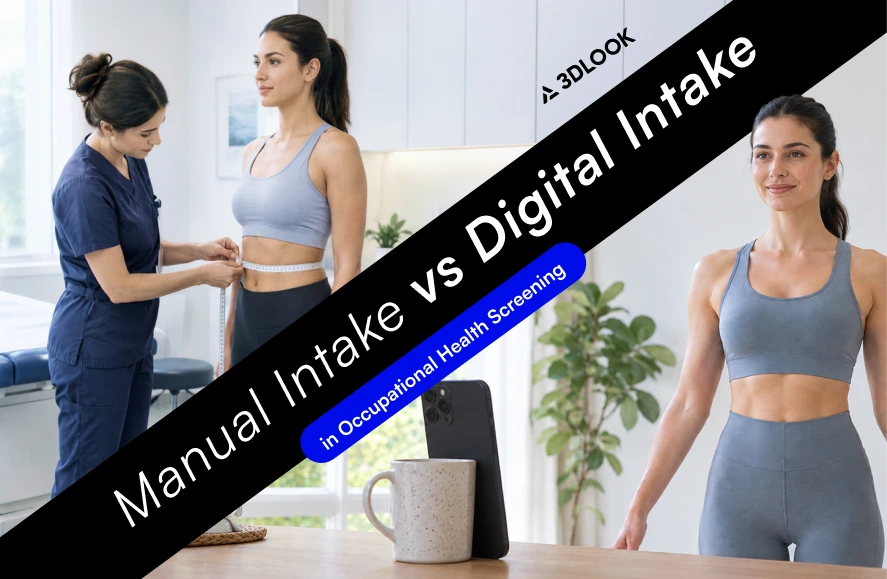
Manual measurement versus guided capture
The appropriate capture method depends on the purpose of the measurement and the program’s protocol.
| Workflow area | Manual measurement at the consultation | Guided scan-based capture |
| Appointment requirements | Requires the patient and trained staff to be in the same location; may occur during a consultation or separate visit | Can be completed remotely before an appointment |
| Cross-operator comparability | Depends on the operator, tool, technique, and participant preparation | Uses a standardized capture and processing sequence; comparability still depends on instructions and quality checks |
| Documentation generated | Staff-entered measurements, with the level of detail set by the program’s protocol | Automatically generated structured record with a timestamp, capture-quality checks, and flags |
| Reuse across pre-qualification, prior authorization, and progress tracking | Depends on how the program records, stores, and retrieves measurements | Can generate the same field structure at several stages |
| Operational dependencies | Trained staff, protocol adherence, measurement tools, and in-person attendance | Smartphone access, capture instructions, retake logic, configured thresholds, and an in-clinic fallback |
Payer acceptance is governed by the plan’s documentation requirements, regardless of the capture method. Manual measurement remains appropriate when a protocol requires an in-clinic method or a clinician needs to locate an anatomical landmark directly. Multi-site programs can use a pilot to compare record completeness and consistency across locations.
What to confirm in a bariatric pilot
A pilot should test the workflow in the program’s patient population and payer mix. Define baseline values and the evaluation period before launch, then separate what the capture produces from what the review team decides.
FitXpress sessions use live capture, real-time pose validation, and clothing detection. When enabled, liveness prompts add further capture-integrity signals. These controls do not remove the need for patient instructions, retake logic, deployment-specific thresholds, accessibility support, or human review.
| What to confirm | The question the pilot answers |
| Capture completion | What share of invited patients complete a usable capture, with and without staff or caregiver assistance? |
| Accessibility and fallback | How do mobility, standing position, smartphone access, available space, language, and clothing instructions affect completion, and when is an in-clinic alternative used? |
| Quality failures and retakes | How often is a capture rejected, and how many attempts are needed for a usable record? |
| Workflow integration | Where is the record stored in the intake system or electronic health record, and which role is responsible for the transfer? |
| Role-based review | Who reviews the record, which criteria apply, and what happens after a discrepancy is flagged? |
| Operational effect | Does earlier capture change time to a completed record, prior-authorization rework, measurement-only appointments, support requests, or follow-up completion? |
| Population fit | How does the patient population compare with the validation scope, including the proportion outside the evaluated weight range? |
| Payer acceptance | Which plans accept the record, for which documentation purpose, and under which conditions? |
| Data governance | What are the rules for retention, access control, Business Associate Agreement scope, output storage, identifier handling, and photo deletion? |
Privacy and security
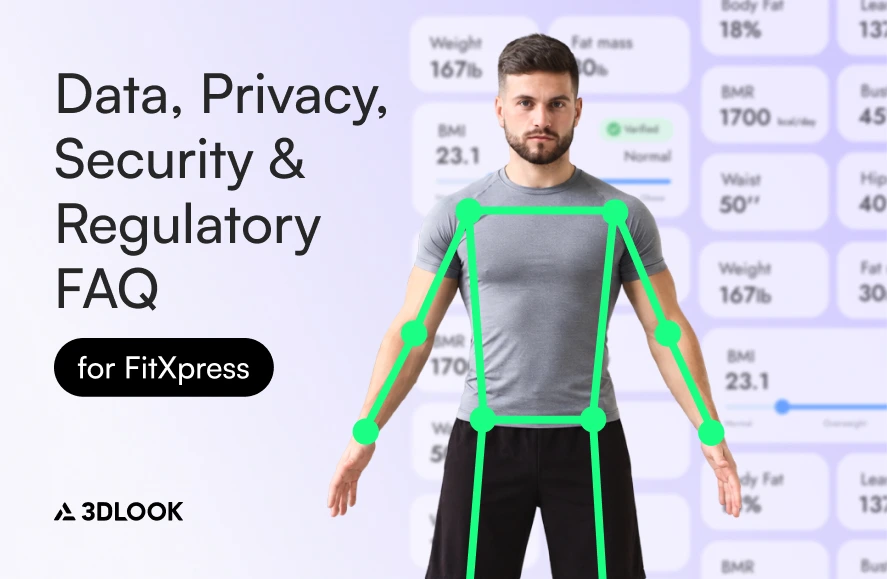
3DLOOK signs Business Associate Agreements with customers covered by the Health Insurance Portability and Accountability Act (HIPAA). In most enterprise deployments, the customer acts as controller and 3DLOOK acts as processor under the General Data Protection Regulation (GDPR). Data are encrypted at rest in Amazon Simple Storage Service (Amazon S3) and in transit using Transport Layer Security (TLS). Photos are deleted immediately after processing or within 30 days, depending on the customer’s policy. For additional detail on data handling, security practices, and deployment responsibilities, see the FitXpress data privacy, security, and regulatory FAQ.
Validation population
The internal validation population included participants aged 16 to 78, heights of 150-220 cm, weights of 38-210 kg, and participants from the US and Europe. Performance outside this scope has not been characterized.
Next steps and related reading
Begin with one workflow and one payer: map the packet requirements against the body-data documentation available on the day of the consultation, then define what would constitute a successful pilot. Request a FitXpress demo or contact the sales team.
FAQ
Smart Scales predicts weight from the capture and can compare that estimate with the self-reported weight, both of which are collected. The program can then review BMI calculated from self-reported height and weight, alongside BMI calculated from the same height and Smart Scales’ predicted weight. A difference above the configured threshold is a signal for human review.
Under CMS-0057-F, beginning January 1, 2026, Medicare Advantage organizations and specified Medicaid and CHIP payers must decide standard non-drug requests within 7 calendar days and expedited requests within 72 hours. Some requests may qualify for an extension of up to 14 additional calendar days under program-specific conditions. The decision-timeframe provisions did not change the requirements for Qualified Health Plans on Federally Facilitated Exchanges, and Medicare fee-for-service is outside these provisions.
No. FitXpress provides body metrics and capture-quality information for review. The licensed program determines clinical eligibility, and the payer makes the prior-authorization decision and determines whether it accepts a scan record for a given documentation requirement.
The required method depends on the program’s protocol, the payer’s documentation rules, and the purpose of the measurement. DXA, bioelectrical impedance analysis, calibrated scales, and clinician-taken measurements remain the methods of record wherever they are required.