Scope note: This article is a tools-evaluation resource for GLP-1 clinics and virtual weight-loss teams, not medical advice. The role any output plays in eligibility, prescribing, or treatment decisions depends on the tool, its regulatory status, the program protocol, and clinician review.
Why Tool Selection Is a Distinct Decision for GLP-1 Clinics
A GLP-1 clinic rarely needs a single tool to perform all measurement tasks. It requires a combination that fits remote delivery, is practical for patients to use repeatedly, and produces data that the care team can review consistently.
GLP-1 programs commonly involve recurring check-ins. Remote and hybrid programs, therefore, require measurement methods that patients can use at home between appointments, while in-clinic equipment remains limited to scheduled visits.
Scale weight alone can obscure what matters during weight change in GLP-1-supported programs. Two members may lose the same amount of weight while one preserves lean mass and the other does not. Scale weight provides a single figure that does not distinguish between changes in fat mass and lean mass. Body composition provides additional context.
Not every category of the evaluated tools is remote, and not every category produces structured estimates of body composition. Professional bioelectrical impedance analysis (BIA) devices, dual-energy X-ray absorptiometry (DXA), and manual clinic measurement all require an in-person visit. Progress photos can support visual engagement, while most wearables provide data on activity and recovery. Neither category typically produces structured body-composition measurements. All seven still belong in this evaluation because remote GLP-1 programs may utilize them as complementary parts of a tracking workflow, with each category serving a different purpose. For the market context behind that framing, see the Growth of the GLP-1 Market.
Short Answer: Which Tools Should a GLP-1 Clinic Evaluate?
Seven tool categories, presented without ranking, constitute the practical landscape that a GLP-1 clinic may evaluate. Each category serves a different purpose, and the appropriate combination depends on the program’s protocol, population, and cadence.
- Connected scales (smart scales with at-home BIA)
- Professional BIA devices (clinic-grade)
- DXA access services
- Mobile body scanning from photos
- Manual measurement (tape, calipers, in-clinic)
- Patient-uploaded progress photos
- Wearables with body-composition estimates
For the definition of body composition and its measuring methods, see how to measure body composition. To learn more about BMI limitations, see beyond BMI.
At a Glance: Comparing the Seven Categories
The seven categories differ across six dimensions.
| Category | Remote capability | Patient burden | Best-supported role | Data structure | Primary cost driver | Best-fit GLP-1 workflow |
| Connected scale | High (at-home) | Low | Frequent weight tracking with directional composition estimates | Structured weight record and device-generated composition estimates | Per-patient or clinic-issued hardware | Recurring at-home weight check-ins |
| Professional BIA (clinic-grade) | In-clinic only | Moderate (requires visit) | Structured in-clinic composition checkpoints | Structured, segmental (device-dependent) | Equipment, software, and staff operation | In-clinic milestone checkpoint for visiting members |
| DXA access services | In-clinic only | High (appointment) | Periodic detailed assessment when required by the program | Structured estimates for detailed assessment | Per-scan service and appointment access | Periodic detailed assessment |
| Mobile body scanning (FitXpress) | High (remote, smartphone) | Low (two photos) | Standardized remote measurements and longitudinal progress tracking | Structured record, 80+ measurements, 3D model, body composition data | Software usage and integration | Remote intake and recurring between-visit check-ins |
| Manual measurement (tape/calipers) | In-clinic only | Moderate | Staff-led in-clinic circumference tracking | Semi-structured, operator-dependent | Staff time and training | Occasional on-site supplement |
| Patient progress photos | High (at-home) | Low to moderate | Visual engagement and qualitative progress | Unstructured | Storage, platform, and review time | Qualitative visual progress tracking |
| Wearables (composition estimate) | High (at-home, worn) | Very low | Activity, sleep, recovery, and selected device-dependent estimates | Device-dependent, often indirect | Per-patient hardware and platform access | Activity and recovery trends between check-ins |
Each category offers a different combination of remote capability, patient burden, data structure, and operational requirements. The appropriate combination depends on the category’s demonstrated role and the decisions the program needs to support.
Why Remote Body Composition Tracking Matters Now
Many GLP-1 programs now operate through remote or hybrid care models. J.P. Morgan Research forecasts the global incretin market, which includes GLP-1s, to reach about $200 billion by 2030, with the number of Americans on GLP-1 treatment rising from roughly 10 million in 2025 toward 25 million by 2030. Employer-sponsored coverage is expanding: the KFF 2025 Employer Health Benefits Survey found that 43 percent of firms with 5,000 or more workers covered GLP-1 drugs for weight loss in 2025, up from 28 percent in 2024.
Body composition can provide important context that scale weight alone does not. Preserving lean mass during weight change in GLP-1-supported programs is a recognized concern: Mass General Brigham clinicians describe lean body mass loss as a consideration during rapid weight reduction, note that it is not unique to GLP-1 therapy, and state that more accurate tools for measuring body composition are needed alongside periodic monitoring. For remote and hybrid programs, the need to distinguish between changes in fat and lean mass makes the selection of tracking tools a deliberate operational decision.
The Seven Tool Categories GLP-1 Clinics Can Evaluate
Connected Scales (Smart Scales with At-Home BIA)
Connected scales combine at-home weight tracking with a device-generated composition estimate in a single measurement session. Representative examples include Withings Body Comp and selected Renpho smart-scale models. Product capabilities vary, and some connected scales provide only weight and calculated BMI without body composition estimates.
- Data captured: weight and device-generated composition estimates produced using BIA; the frequency, measurement method, and available outputs vary by device (commonly body fat percentage)
- Where capture occurs: at home, unsupervised
- Hardware required: a connected scale (member-owned or clinic-issued)
- Integration options: most consumer models sync through a manufacturer’s companion app; enterprise or API-level data access varies by manufacturer and should be confirmed directly with the vendor
- Main source of variability: home BIA estimates can vary with hydration, food intake, exercise, and measurement timing. Standardized conditions are important when comparing readings over time.
- Best role in a GLP-1 workflow: high-frequency weight tracking with directional composition estimates; suitability for milestone assessments depends on the device, its validation, and the program protocol.
- Questions to ask the vendor: What frequency does the device use? Is data exportable through an API? What conditions does the manufacturer recommend for consistent readings?
For depth on where connected scales fit, see body composition scale.
Professional BIA Devices (Clinic-Grade)
Clinic-grade BIA systems support structured in-clinic composition checkpoints. Representative examples include InBody analyzers, Seca’s mBCA line, and Tanita professional devices.
- Outputs: estimated segmental body composition (arm, leg, trunk), body fat percentage, and lean mass; specifics vary by device
- Where capture occurs: in-clinic, supervised
- Hardware required: a clinic-grade BIA analyzer
- Integration options: device-dependent; many clinic systems export through proprietary software rather than an open API
- Main source of variability: hydration and physiological state can influence professional and home BIA results. Professional BIA systems may provide multi-frequency and segmental estimates, depending on the device.
- Best role in a GLP-1 workflow: structured composition checkpoints during in-person visits; remote monitoring requires a separate at-home method.
- Questions to ask the vendor: Is the device single- or multi-frequency? What validation population was it tested against? Can results be exported in a structured, comparable format?
For method depth, see BIA scanning and the InBody vs 3DLOOK comparison.
DXA Access Services
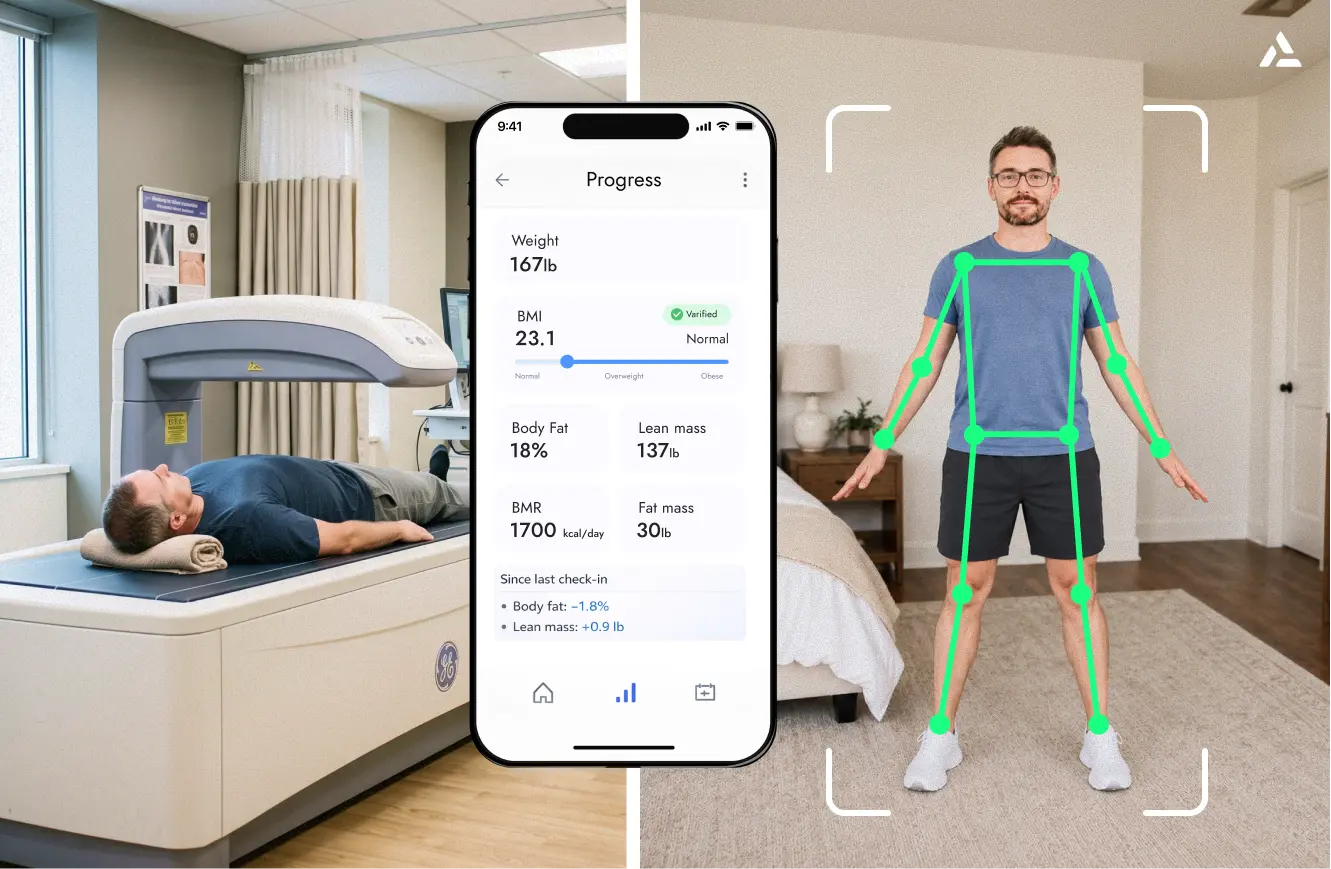
Dual-energy X-ray absorptiometry (DXA) provides detailed estimates of fat mass, lean mass, and bone mineral content and is commonly used as a reference method for body composition assessment. Access services route members to an imaging center or hospital-based facility for a scan. Representative examples include DXA systems manufactured by Hologic and GE Healthcare, typically accessed through a hospital or imaging-center radiology department or through direct-access scan services such as BodySpec.
- Outputs: estimated fat mass, lean mass, bone mineral content, and regional breakdowns
- Where capture occurs: an imaging center or hospital, appointment-based
- Hardware required: no scanning equipment at the clinic; the external imaging provider operates the equipment
- Integration options: results typically arrive as a report (PDF or portal export); the delivery format should be defined with the imaging provider
- Main source of variability: device calibration and scan protocols vary across imaging sites. Comparability depends on the facility, device model, and protocol used.
- Best role in a GLP-1 workflow: periodic detailed assessment when required by the program; its appointment-based delivery generally limits the frequency of use.
- Questions to ask the vendor: What is the appointment lead time and geographic coverage? How is the report delivered, and can it be structured for the patient record? What is the cost per scan at program volume?
For a full comparison of DXA and mobile methods, see AI body scanners vs DXA scans.
Mobile Body Scanning from Photos (FitXpress)
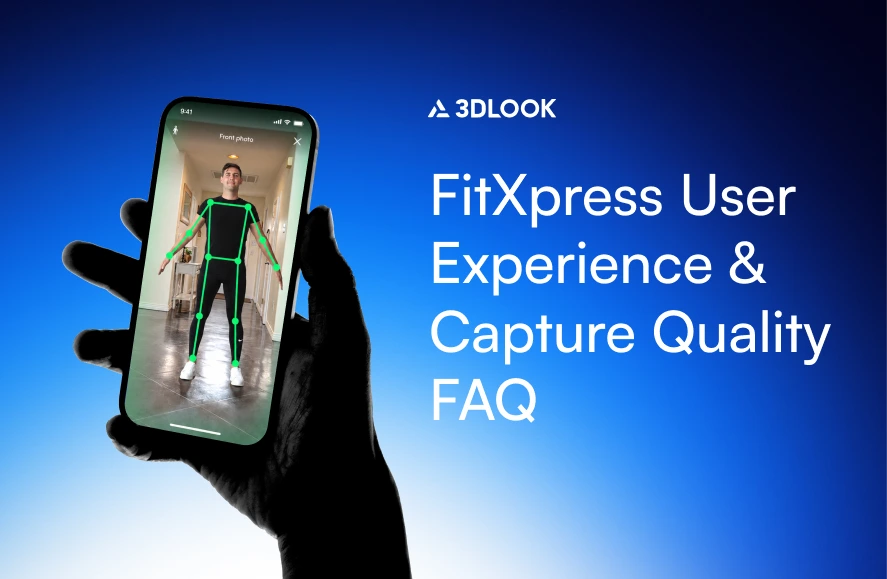
Mobile body scanning uses two smartphone photos, front and side, to generate body measurements, calculated and estimated outputs, and a 3D model without dedicated scanning hardware. In the FitXpress implementation, processing typically takes approximately 30–45 seconds.
- Outputs:
– Body measurements generated from image analysis (80+ measurements)
– Calculated outputs such as BMI and BMR
– Estimated composition outputs, including body fat percentage, lean mass, and fat mass
– A 3D model
- Where capture occurs: remotely using a smartphone under the required capture conditions; no clinic visit required
- Hardware required: a smartphone with a camera; no dedicated scanning hardware
- Integration options: white-label delivery via application programming interface (API) and software development kit (SDK)
- Main source of variability: capture conditions (distance, lighting, pose), a guided capture flow, and retake logic reduce
- Best role in a GLP-1 workflow: remote intake and recurring between-visit check-ins that produce a structured record for review
- Questions to ask the vendor: What validation population and reference method were used? How repeatable are results under normal at-home conditions? What happens to photos after processing?
For most evaluated measurements, repeated scans showed typical scan-to-scan differences of less than 1 cm. This repeatability supports more consistent longitudinal comparison when scans are completed under similar capture conditions, and FitXpress is intended to show meaningful progress over time rather than very small short-term changes. Separately, compared with expert manual measurements, FitXpress reports 96–97% accuracy with a typical error margin of 1.5–2.0 cm. These figures represent two distinct benchmarks based on different reference methods. The full mobile body-scanning accuracy framework distinguishes accuracy benchmarks by decision and reference methods.
FitXpress’s predicted-weight output showed a mean absolute error of approximately 3.5% in the evaluated dataset under the specified capture conditions. This is a software estimate, not a physical scale reading. For how hardware scanners and mobile capture differ, see body scanner machines vs mobile 3D body scan.

Discover how AI-powered body intelligence is reshaping GLP-1 programs, telehealth, and digital health, from accurate remote assessments to safer and more engaging patient journeys.
Manual Measurement (Tape, Calipers, In-Clinic)
Manual anthropometry uses a trained staff member with a tape measure and calipers during an in-person visit, providing staff-led in-clinic circumference tracking.
- Data captured: directly measured circumferences and skinfolds; body-composition values may then be estimated using equations.
- Where capture occurs: in-clinic, staff-administered
- Hardware required: tape measure and calipers; minimal device budget
- Integration options: typically manual entry into the patient record; no native structured export
- Main source of variability: results can vary between staff members and across sessions, particularly when measurement landmarks and protocols are applied inconsistently
- Best role in a GLP-1 workflow: occasional in-clinic measurement that supplements the remote progress record when a clinician is already present
- Questions to ask (internal protocol): Is there a standardized measurement protocol across staff? How is inter-rater consistency checked?
Patient-Uploaded Progress Photos
Self-captured progress photos require no dedicated measurement hardware and can provide a visual record of change. Some programs include them as a qualitative complement to structured progress data.
- Data captured: unstructured images; no numeric measurement
- Where capture occurs: at home, member-captured
- Hardware required: a smartphone camera
- Integration options: typically stored in a patient app or portal as an image, not a structured data field
- Main source of variability: patient photos usually provide qualitative rather than structured measurement data. Differences in pose, distance, clothing, lighting, and camera angle can limit direct comparison.
- Best role in a GLP-1 workflow: visual engagement and qualitative progress tracking as a complement to structured measurement data
- Questions to ask the vendor: Is there guidance for consistent pose, distance, and lighting? Is the photo stored alongside structured measurement data from the same session?
For turning visual progress into something that supports adherence and retention, see visual progress tracking for GLP-1 adherence and retention.
Wearables with Body-Composition Estimates
Some wearables provide device-specific body-composition estimates, often through on-demand impedance measurements. Representative examples include Samsung Galaxy Watch models with on-device bioelectrical impedance sensors to estimate metrics such as body fat percentage and skeletal muscle mass. The wider category remains more established for activity, sleep, heart rate, and recovery data than for body composition.
- Data captured: activity, sleep, heart rate, and recovery data as the core function; body-composition estimates only on select devices, usually through an on-demand reading
- Where capture occurs: worn at home or throughout the day
- Hardware required: a wearable device (wrist-worn or similar)
- Integration options: most consumer wearables sync through a companion app; API access to composition-specific data varies widely by manufacturer
- Main source of variability: device-dependent; the estimation method and its accuracy vary significantly across manufacturers and models
- Best role in a GLP-1 workflow: activity and recovery tracking between check-ins, with device-dependent composition estimates used alongside a structured capture method where appropriate
- Questions to ask the vendor: Does the device estimate body composition at all, or only activity and recovery metrics? If so, on what basis, and how was it validated?
How to Build the Right Tool Mix
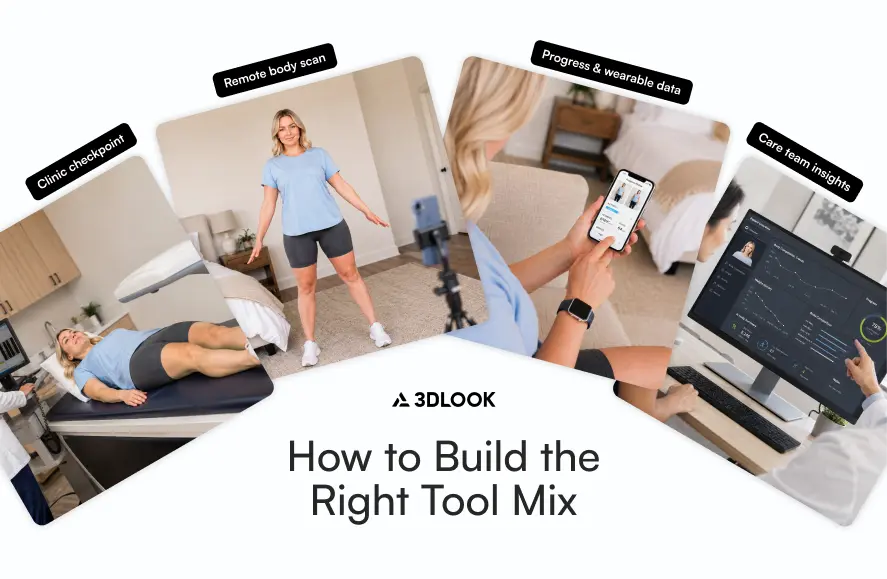
A hybrid model may suit programs that require periodic in-person assessment while also needing more frequent remote progress data. The appropriate combination is determined by the program’s clinical protocol, patient population, cadence, and operational requirements.
One possible model pairs a category designed for periodic, detailed in-clinic assessment, such as DXA or professional BIA, with a category designed for frequent, low-burden remote capture, such as connected scales or mobile body scanning. A program may also add progress photos or a wearable that supports its engagement strategy. For the compliance dimension specific to GLP-1 delivery, see the GLP-1 compliance challenge; for regulated BMI-verification workflows, see the online pharmacy BMI verification guide.
Buyer Checklist
Score every candidate tool against the same questions, regardless of category:
- What output does the tool measure directly, and what does it estimate?
- What reference method and population were used for validation?
- How repeatable are results under normal at-home conditions?
- What instructions and capture-quality checks are included?
- What hardware must the clinic or patient purchase?
- Can results be exported through an API?
- How are photos, measurements, identifiers, and session data retained?
- Can the tool support the intended patient volume and check-in cadence?
- Where is clinician review required?
- Which program decisions should the output explicitly not support?
Where FitXpress Fits and Where Other Methods Remain Necessary
FitXpress represents mobile body scanning in this landscape, providing GLP-1 programs with a remote layer for structured body data capture. It supports remote intake and recurring between-visit assessments without dedicated scanning hardware, producing structured records for clinician review. The solution is delivered as a white-label integration through an API or SDK.
Where a program’s protocol requires DXA, professional BIA, or a calibrated scale, those methods retain their role. Mobile scanning can support remote capture between in-person assessments or serve as the primary structured progress-tracking method when the protocol does not require other methods. Weight-management programs use production technology for recurring remote progress check-ins.
The resulting records include structured body measurements and estimated body-composition outputs. FitXpress is not a medical device and does not diagnose conditions or determine treatment, prescribing, or eligibility. Programs should retain calibrated scales, professional BIA, DXA, or other methods wherever required by their protocols.
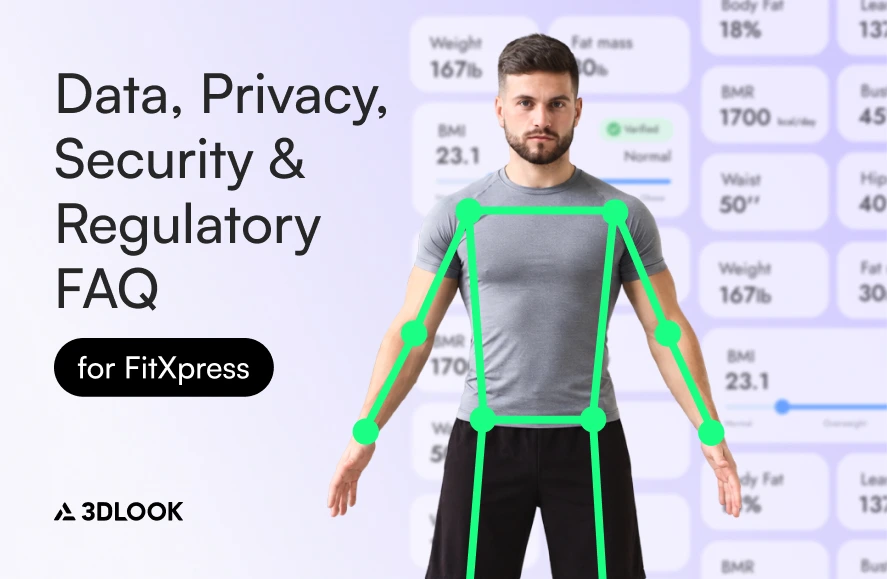
The product supports deployments compliant with the Health Insurance Portability and Accountability Act (HIPAA), and a Business Associate Agreement is available upon request. It is aligned with the General Data Protection Regulation (GDPR). Data is encrypted at rest using AWS S3 server-side encryption with Amazon S3-managed keys (SSE-S3). Production photos are deleted after processing. Structured outputs and session data are retained in accordance with the customer’s deployment and contractual configuration. For a detailed overview of FitXpress data handling, retention, deletion, security controls, and regulatory status, see the FitXpress data privacy and security FAQ. The 3DLOOK Terms & Policies page provides the applicable privacy documents.
For the product view, see FitXpress for telehealth and digital health programs; for the broader data context, see the AI Body Data for Health hub.
Implementation and Evaluation Considerations
Capture conditions shape the quality of any remote measurement, and rollout details matter as much as the tool itself. A guided capture flow, retake logic, and consistent conditions across sessions reduce variability. Clear member instructions and deployment-specific thresholds provide additional controls for capture consistency.
Programs may establish a baseline at intake and schedule subsequent captures around their check-in protocol. Run a time-boxed pilot before committing at scale, and measure capture completion rate, record consistency across sessions, and clinician review time. These measures provide operational evidence that complements vendor specifications. API and SDK delivery allow customers to connect outputs to their existing applications and data workflows, providing the care team with structured data within the systems it already uses.
Next Steps
Tool choice for a GLP-1 clinic is a workflow-fit decision. The appropriate combination depends on the program’s clinical protocol, patient population, cadence, and operational requirements. Programs can combine a category designed for periodic, detailed, or in-clinic assessment with one designed for frequent, low-burden remote capture, allowing progress data to be collected across different stages of the program.
Explore FitXpress for telehealth and digital health programs to learn how it supports remote progress tracking for GLP-1 programs.
FAQ
The appropriate tool combination depends on the program’s protocol, patient population, check-in cadence, and measurement requirements. Connected scales, professional BIA, DXA access, mobile body scanning, manual clinic measurement, patient photos, and wearables each trade remote capability, burden, and cost differently, and programs can combine more than one category to cover both periodic and frequent check-ins.
Mobile body scanning serves a different role. It supports lower-burden remote measurements and longitudinal comparison, while DXA, professional BIA, calibrated scales, and other methods remain appropriate wherever required by the program’s protocol.
It depends on the category. Depending on the method, tools directly measure weight or circumferences, or estimate outputs such as fat mass, lean mass, and body fat percentage. FitXpress generates body measurements from image analysis and produces calculated and estimated composition outputs, including BMI, BMR, and body fat percentage.
Programs may establish a baseline at intake and schedule subsequent captures around their check-in protocol. The program’s clinical protocol should determine the exact cadence.
Its role depends on the tool, its regulatory status, and the program protocol. FitXpress provides supporting body-data estimates for clinician review and does not independently determine eligibility, prescribing, or treatment.
It is not positioned as a medical device.
Connected scales, supported wearables, progress photos, and mobile body scanning can all be used from home. The patient effort involved depends on device setup, capture instructions, scan frequency, and the need for retakes.
Accuracy depends on the reference point. For most evaluated measurements, repeated scans showed typical scan-to-scan differences of less than 1 cm. Against expert manual measurement, FitXpress reports 96–97% accuracy, with a typical error margin of 1.5–2.0 cm.