Virtual try-on for clothes has moved from augmented reality (AR) filters and in-store mirrors into search engines and AI assistants. Google brought AI try-on to Search in the US in July 2025, and OpenAI added a Try On button to ChatGPT on October 1, 2026.
Virtual clothing try-on shows a garment on an image of the shopper. That image comes from a live camera view, a 3D avatar, or a photo processed by an AI model. The approaches differ in cost, catalog coverage, and how much they reveal about fit.
Virtual try-on for clothes: the short answer
- What it is. Software that shows a garment on an image of the shopper.
- How it works. Shoppers try on clothes virtually through AR overlays on a live camera, 3D avatars with simulated garments, or generative AI images made from a photo.
- Where to find it. Search engines, AI assistants, retailer websites and apps, and some in-store screens.
- What it helps with. Judging color, style, and proportions on the shopper’s own photo before buying.
- How close it gets to fit. It varies by approach: 3D avatars come nearest but need a 3D model of every product, and generated images can get fit details wrong.
A try-on image can settle the look, while size for custom and made-to-measure orders comes from body measurements, which Mobile Tailor captures from smartphone photos.
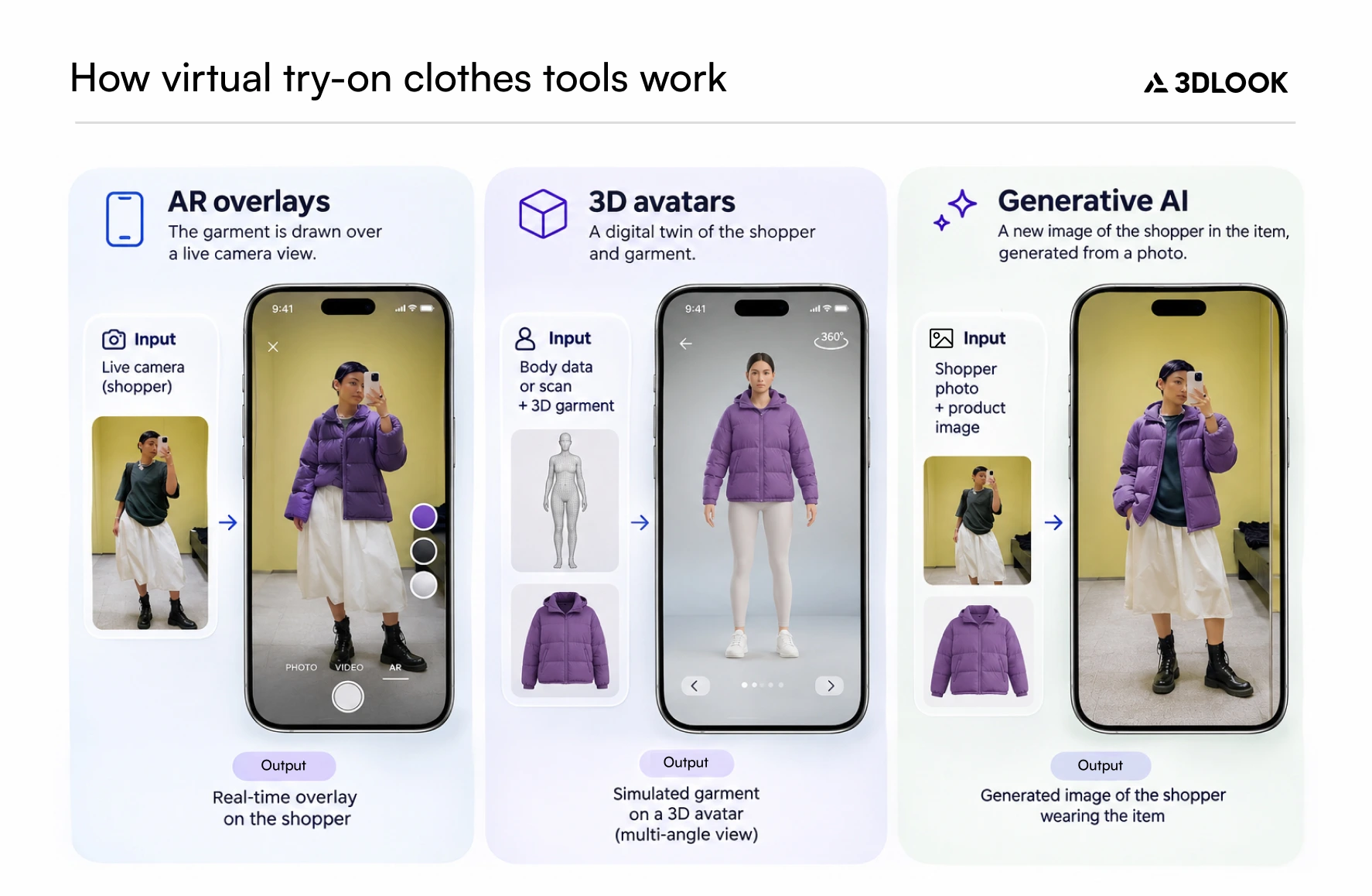
How virtual try-on clothes tools work: AR overlays, 3D avatars, and generative AI
Each approach needs different input from the shopper and the brand, and each returns a different kind of image.
AR overlays on a live camera
In AR clothing try-on tools, the camera on a phone or an in-store screen tracks the shopper’s body or face. Software draws the garment over the live image in real time, and the overlay moves with the shopper. AR works best for shoes, eyewear, accessories, and tops, where the item sits on a clear point of the body. Drape and size are approximate, most visibly on loose or long garments.
3D avatars and simulated garments
A 3D avatar is built from the shopper’s height, weight, and body measurements, or from a scan made with body scanning technology for apparel. Each garment needs a 3D digital twin that carries its fabric properties. The software simulates the garment on the avatar, taking fabric behavior and the shopper’s fit preference into account. Shoppers can turn the avatar and see the garment from several angles.
Of the three approaches, 3D virtual try-on is the nearest thing to a fit preview. It is also the most expensive to run, because every product needs its own 3D asset. How close the preview gets depends on both inputs: the body data and the quality of the garment’s digital twin.
Generative AI from a single photo
The shopper uploads a full-length photo or a selfie. An image model then generates a picture of the shopper wearing the item. AI virtual try-on for clothes covers a whole catalog without 3D assets, because the model works from ordinary product images. Google’s try-on and ChatGPT’s Try On both work this way. The result is a generated image of how the item could look on the shopper.
Virtual fitting rooms in stores and online
Live video try-on, where the garment follows the shopper in real time, runs mainly on AR. Shoppers find it as lenses in camera and retailer apps and on in-store screens.
In stores, a virtual fitting room is usually a smart mirror or a screen in or near the fitting area. Tesco began testing one in September 2026, in the F&F clothing department of its Sandhurst Extra store, Retail Gazette reported. The screen works from a still photo. Shoppers take one on the spot or upload one, then try on about 1,500 F&F menswear and womenswear items.
Online, the fitting room is usually a try-on button or widget on the product page. It runs on an AR overlay, a 3D avatar, or a generated image, and some retailers call it a virtual dressing room. The main software types, and what each offers a retailer, are compared in the overview of virtual fitting room technology for ecommerce.
Brands and platforms offering virtual try-on in 2026
Shoppers who want to try on clothes online now find the widely available tools in search engines, AI assistants, and retailers’ own shops. Eyewear and accessory try-on has run on live AR for longer.
- Google. Google’s virtual try-on for clothes launched for US shoppers in July 2025, across Search, Google Shopping, and product results in Google Images. In December 2025, it reached the UK and India, and Google added a selfie option in the US.
- Doppl (Google Labs). Google Labs launched Doppl, an experimental try-on app, in the US on iOS and Android in June 2025. It shows outfits from photos or screenshots on an animated digital version of the shopper.
- ChatGPT (OpenAI). OpenAI launched a Try On button in ChatGPT’s shopping results globally on October 1, 2026, TechCrunch reported. It works from a selfie or a full-body photo, and a Favorites library for saved products arrived with it.
- Zara. Zara Try-On has run on Zara.com since mid-December 2025. Shoppers create a synthetic avatar from their own photos, and AI generates images of it wearing real products. In its full-year 2025 results, published in March 2026, Inditex said the tool was live in 43 markets, with more than 7 million sessions.
All four use generative AI and work from ordinary photos. That makes generative try-on the approach most shoppers are likely to meet first.
How to try on clothes virtually before you buy
To try on clothes virtually, choose a tool that supports try-on for the item and add a full-length photo or a selfie. Then review the generated image before you buy.
You have five main routes:
- Google Search or Shopping. Tap the “try it on” icon on a supported apparel listing and upload a full-length photo. Shoppers in the US can also start from a selfie.
- ChatGPT. Select Try On in the shopping results, or upload a screenshot of an item and ask ChatGPT to try it on.
- A retailer’s own website or app. Look for a try-on option on the product page, where the retailer offers one.
- An in-store screen. Some stores now test try-on screens in the clothing department.
- AR lenses. Camera and social apps show some items on you through the phone camera, in real time.
AR virtual try-on apps for clothes fall into two groups: camera and social apps with lenses, and retailers’ own apps. Coverage depends on which items each brand has prepared for AR.
The widely available platforms for trying on clothes virtually run on phones, laptops, and in-store screens. None of them needs a virtual reality (VR) headset.
A few habits improve the result. Google recommends a full-body shot, good lighting, and fitted clothing for the photo. Before uploading, look at what the tool does with the photo. For jeans, a tailored jacket, or anything else cut close to the body, compare your own measurements with the brand’s size chart before ordering.
What virtual try-on does for fashion brands
Confidence before purchase. Shoppers see the item on their own photo before they order. Retailers are still measuring what that changes, and Tesco’s in-store trial is one such test.
Engagement and sharing. Google’s try-on and Doppl allow shoppers to save a look and share it with friends. ChatGPT keeps try-on images alongside the products saved to Favorites. For a brand, a saved or shared look can keep a product in view after the session ends.
Returns. Retailers estimated that 15.8% of their annual sales would be returned in 2025, and 19.3% of online sales. The figures come from the National Retail Federation’s 2025 Retail Returns Landscape report and cover every retail category, apparel among them. A garment can come back because it looks different than expected, or because the size or cut is wrong. Try-on can help with the first cause. The published summary does not break those figures down by cause.
Can virtual try-on show which size will fit?
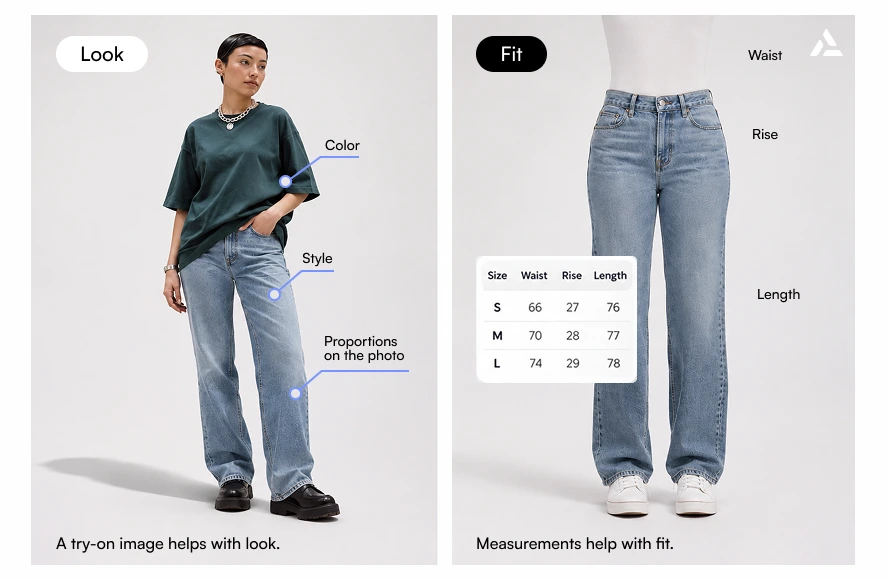
Realistic sizing for jeans, in a virtual fitting room or anywhere else, starts with the shopper’s waist, hip, thigh, rise, and inseam. Those measurements are compared with the brand’s size chart or the garment’s own measurements. A try-on image shows the cut and color on the shopper’s photo.
Google’s own tools leave the size decision with the shopper. Its selfie try-on, launched in the US in December 2025, asks shoppers to select their usual clothing size. The Doppl announcement adds a caveat: “Fit, appearance and clothing details may not always be accurate.”
For how clothes will look in person, a try-on image and product photos on models of a similar build together give a fuller picture. For fit, the shopper compares body measurements taken at home with the size chart.
A true fit preview would show how long a garment runs, how it sits on the hips, and whether it pulls at the waist. That takes two sets of data: the body’s measurements and the garment’s pattern measurements. 3D avatar tools come closest, for the products a brand has digitized.
Body measurements for made-to-measure, rental, and uniform orders
Some clothing businesses need measurements more than images. Made-to-measure brands and tailors cut each garment from the wearer’s measurements. Formalwear rental companies allocate sizes from them, as do uniform programs in workwear, personal protective equipment (PPE), healthcare, and public safety. On-demand clothing manufacturers produce each order after it is placed. In all of these businesses, a wrong measurement turns into a remake, an alteration, or a reshipment.
A body measurement app for clothing can collect those measurements remotely, from a phone. 3DLOOK’s Mobile Tailor provides 80+ body measurements from 2 photos for precise custom fit, without an in-person fitting. To capture body measurements with Mobile Tailor, the person being measured takes front and side photos with a smartphone. Structured outputs return in under 45 seconds. The production-ready measurements and 3D models feed pattern, design, and order-management automation. Uniform programs use it to measure large groups remotely, which can reduce fitting events, alterations, and order-to-delivery time.
Mobile Tailor does not render garments on a person or offer virtual try-on.
Companies use the measurements inside their own ordering and production systems:
- A custom-fit PPE manufacturer runs the scan inside its customer ordering flow. The measurements feed its pattern and manufacturing pipeline, and their consistency helps avoid remakes.
- A formalwear rental company has wedding parties scan from their own phones. Each result feeds the customization of that member’s order, and the company has used Mobile Tailor for nearly 5 years.
- A 3D configurator for custom apparel takes Mobile Tailor measurements as its input.
A loose T-shirt can absorb centimeter-level measurement error, but a tailored jacket or made-to-measure trousers sit close enough to the body for it to show. Internal validation across multiple real-world scan events with five repeated scans per person against expert pattern-maker manual measurements shows 3DLOOK’s measurement accuracy of approximately 96-97% across body metrics, with a typical absolute error of 1.5-2.0 cm per measurement, varying by body part. Detailed methodology, including sample size, measurement-level results, and the definition of repeatability used in the analysis, is available under NDA. The framework for reading body-scanning accuracy figures explains how to judge that error for apparel sizing.
What comes next for virtual try-on
Try-on images will likely keep improving and spreading as more search engines, AI assistants, and retailers add the feature. Inditex said in March 2026 that Zara’s tool is being rolled out to the group’s other brands. Teams that run made-to-measure, formalwear rental, or uniform programs and need the body measurements behind each order can see how Mobile Tailor works.
FAQ
Google’s and ChatGPT’s try-on work from a photo of you, and Zara Try-On builds a synthetic avatar from your photos. 3D avatar try-on appears on individual brand sites, for the products each brand has digitized. In custom clothing, a 3D body model from a phone scan feeds production. The brand takes its measurements to make the garment.
Usually, yes. Google’s try-on sits on apparel listings in Search and Shopping, which are free to use. Retailer features such as Zara Try-On are part of the store itself. Availability varies by country, product, and service.
It depends on the tool. Some keep an image for reuse: Google’s selfie option asks you to pick a generated image as your default try-on photo. Before uploading, read the tool’s privacy policy and check its settings. Look for whether the photo is stored, for how long, and whether you can delete it.