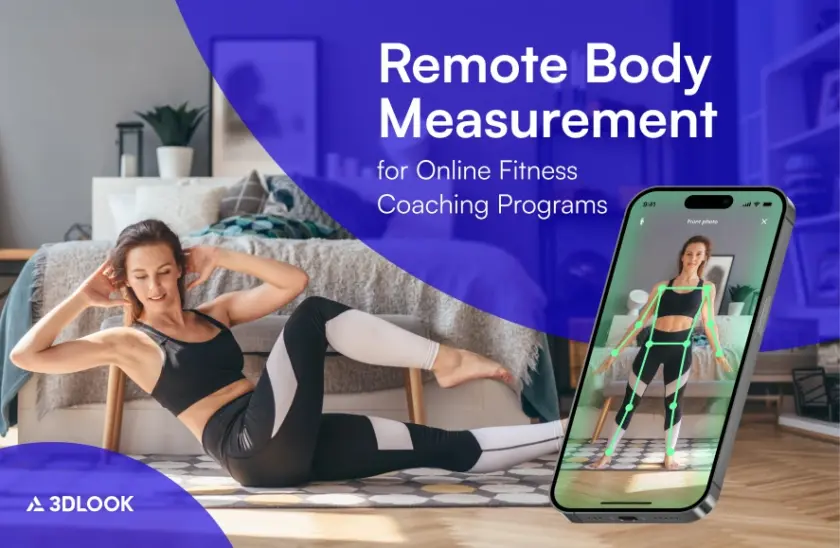
Online fitness coaching programs need a consistent way to collect body measurements when clients and coaches are in different locations. A guided smartphone scan can support onboarding and recurring check-ins without requiring an in-person appointment.
Operational value depends on fit with the program’s cadence, coach workflow, and interpretation policy. Broader context on body data, progress tracking, and personalization is available in the AI in the fitness industry hub.
Scope note: FitXpress supports non-clinical fitness intake and progress tracking. FitXpress is not a medical device. It does not diagnose conditions, make clinical decisions, or determine treatment eligibility.
The measurement problem in online fitness coaching programs
Remote programs often combine home-scale weight, client-taken progress photos, and self-measured circumferences. Comparability depends on consistent devices, timing, pose, framing, clothing, and technique. Those conditions may be absent from the client record:
- Body weight varies with hydration, food intake, time of day, and the scale used.
- Circumferences vary with tape placement and tension.
- Lighting, camera position, distance, and posture affect progress photos.
- A record without capture context may reflect measurement variation, physical change, or both.
A scalable workflow needs repeatable capture instructions, structured results, and a defined interpretation policy. These controls improve longitudinal comparison and reduce manual entry, review, and retakes.
What remote body measurement provides
FitXpress uses two smartphone photos, one front view and one side view, along with relevant profile inputs. Processing typically takes under 45 seconds and can return five categories of output:
- More than 80 body measurements
- Body-composition estimates, including body fat percentage, lean body mass, and fat mass
- BMI and basal metabolic rate (BMR)
- Smart Scales, a software-based predicted-weight output with an average prediction error of approximately 3.5% under evaluated conditions
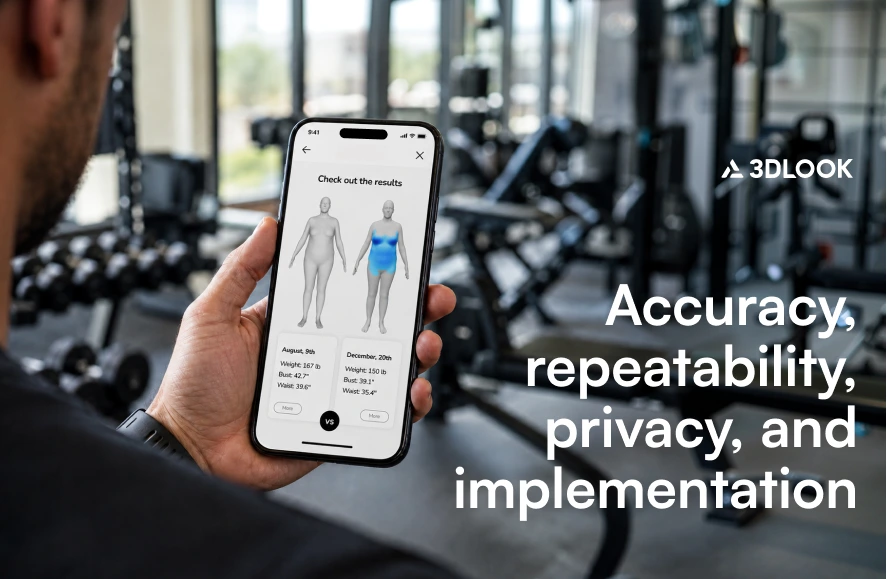
- A 3D body model that supports visual comparison between check-ins.
Each category has a different method and interpretation. Circumferences are generated from the reconstructed body model. Body-composition estimates apply established formulas to model-generated measurements and relevant profile values. BMI and BMR are calculated metrics. Smart Scales predicts weight from the scan pipeline. The platform’s client-facing interface should label these categories clearly and present circumference trends alongside composition estimates and weight data.
How remote body measurement fits the coaching workflow
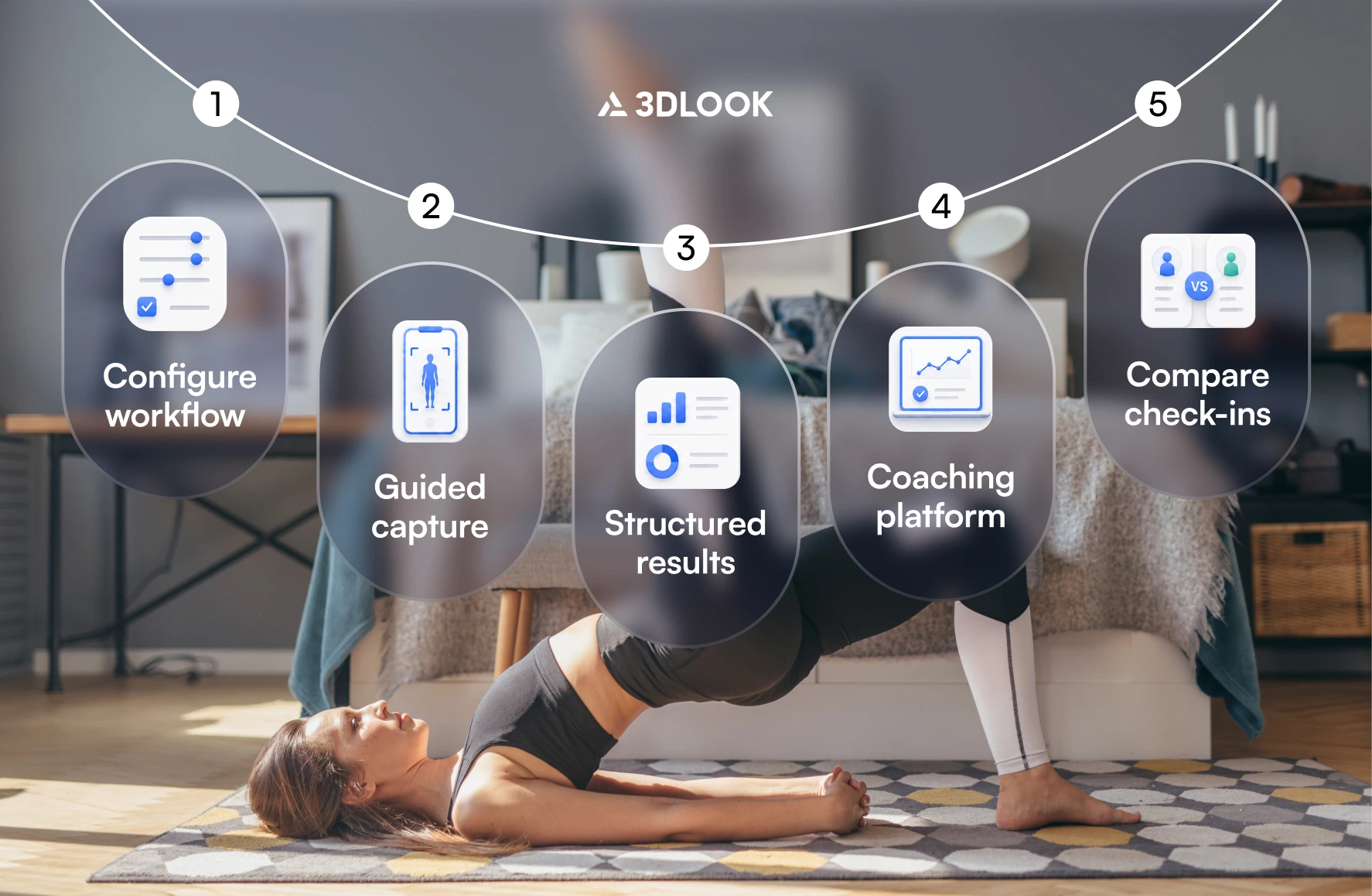
Programs can integrate the scan into an existing schedule, with a baseline during onboarding and follow-up scans at defined check-in points.
- Configure the workflow. The program selects the required outputs, profile fields, notices, consent flow, retention rules, and comparison view.
- Capture a baseline. Visual and voice guidance supports the capture of front and side photos. Quality checks assess pose, framing, and other input conditions and can prompt an adjustment or retake.
- Generate structured results. The scan pipeline processes the photos and profile inputs, then returns the configured data.
- Present results in the coaching platform. A mobile or web software development kit (SDK) embeds guided capture. An application programming interface (API) submits scan data and retrieves results. The fitness platform presents selected outputs to coaches and clients.
- Compare check-ins. The platform can display current and previous measurements and 3D models. The coach reviews changes with other program information and remains responsible for coaching decisions.
Cadence depends on program duration, expected change, measurement variability, client burden, and the decisions supported. The platform can configure scan timing according to the program’s check-in schedule.
How coaches can use the results
Structured body data can support four common coaching stages.
| Coaching stage | Data reviewed | Supported coach action | Interpretation boundary |
| Onboarding | Baseline measurements and 3D model | Establish a standardized starting record | The outputs do not prescribe a program |
| Recurring check-in | Measurement, weight, and composition trends | Review progress with training, nutrition, adherence, and client-reported information | Small differences may reflect expected measurement variation or capture conditions |
| Apparent plateau | Weight and regional measurement trends | Examine whether different progress indicators show the same pattern | The scan does not determine the cause of a plateau |
| Program completion | Longitudinal measurements and visual comparison | Summarize changes recorded during the program | The record does not establish that one intervention caused the observed changes |
A difference between scans should be interpreted in relation to expected scan-to-scan variation and the conditions of each capture. Training, nutrition, sleep, hydration, and other factors may affect the record. FitXpress provides structured body data and comparison outputs; the coach remains responsible for interpretation and program decisions.

Discover how AI-powered body intelligence is reshaping GLP-1 programs, telehealth, and digital health, from accurate remote assessments to safer and more engaging patient journeys.
Comparison with scales, tape measurements, photos, bioelectrical impedance, and dual-energy X-ray absorptiometry
Method selection depends on the decision, required evidence standard, capture frequency, available equipment, and client access.
| Method | Primary output | Main source of variation or limitation | Potential coaching role |
| Client-reported scale weight | A body-weight reading | Timing, hydration, food intake, device quality, and calibration affect comparability | Frequent tracking when collection conditions are documented |
| Self-measured tape circumferences | Selected circumferences | Landmark placement, tape angle, tension, and technique can vary | Remote check-ins with clear protocols and training |
| Consumer smart scale | Weight and an impedance-based composition estimate | Weight depends on device accuracy and calibration; composition also depends on the equation, hydration, and measurement conditions | Home weight trends and supplementary composition estimates |
| Professional bioelectrical impedance analysis (BIA) | Whole-body or segmental composition estimates, depending on the device | Results depend on the analyzer, equation, preparation protocol, and measurement conditions; access requires suitable equipment | Periodic assessment with standardized equipment and preparation |
| Dual-energy X-ray absorptiometry (DXA) | Imaging-based estimates of body composition and regional distribution | Access, cost, appointment requirements, preparation, and positioning depend on the provider and protocol | Periodic assessment when the program requires this reference method |
| Progress photos | A visual record | Clothing, lighting, pose, framing, and camera position affect the comparison | Qualitative progress review and client communication |
| Mobile body scan | Body measurements and composition estimates, calculated metrics, predicted weight, and a 3D model | Results depend on capture conditions and the evaluated performance of each output | Standardized remote intake and longitudinal comparison across a distributed roster |
A connected or calibrated scale provides a direct weight reading. Professional BIA estimates body composition through electrical impedance. A review of BIA accuracy and standardization highlights differences among analyzers and equations, as well as the need for standardized protocols. DXA is used for imaging in clinical and research settings. A DXA methodology review focused on athletes and active people proposed standardized preparation and positioning for interpreting small changes.
Mobile body scanning adds remote circumference data and a consistent visual model. The appropriate method or combination is determined by the decisions the program needs to support, evidence requirements, access, and cadence. A comparison of two-photo, video, and hardware body scanning explains the operational differences among these approaches.
Where FitXpress fits
FitXpress provides a remote body data capture and scan comparison layer for a fitness coaching platform. The SDK embeds guided capture in a mobile or web experience. The API submits scan data and retrieves structured results. The implementation can return the measurements, estimates, calculated metrics, predicted weight, and models relevant to the program.
The coaching platform manages scheduling, program logic, and the presentation of coach and client views. Responsibilities for data processing, storage, access, and retention depend on the deployment architecture, contract, applicable law, and customer policy.
Implementation details and fitness-specific workflows are available on the FitXpress for connected and digital fitness page.
Accuracy, repeatability, privacy, and implementation
Accuracy and repeatability
Accuracy requirements depend on the intended decision, reference method, capture protocol, population, and acceptable error. Multi-week circumference tracking has different requirements from a workflow that requires calibrated weight or a clinical body-composition reference.
According to the mobile body-scanning accuracy framework, internal validation against expert pattern-maker manual measurements reported approximately 96-97% agreement across the evaluated body metrics. Typical absolute error was generally 1.5 to 2.0 cm and varied by measurement and body part. The disclosed population covered ages 16 to 78, heights from 150 to 220 cm, weights from 38 to 210 kg, and participants from the US and Europe. Populations outside that scope require separate evaluation.
Repeatability is particularly relevant to longitudinal tracking. For most evaluated measurements, repeated scans showed typical scan-to-scan differences of less than 1 cm. These are internal results; detailed methodology and measurement-level findings should form part of deployment diligence.
Very small short-term differences may fall within expected variability. Longitudinal use requires consistent capture conditions and a defined change threshold for coaching review.
Privacy and consent
Data-processing, access, and retention requirements should be defined before production. FitXpress maintains Health Insurance Portability and Accountability Act (HIPAA) compliance in US healthcare environments and adheres to General Data Protection Regulation (GDPR) principles for European deployments. Data is encrypted in transit and at rest.
In most enterprise deployments, the customer acts as controller and 3DLOOK acts as processor under GDPR. The customer is responsible for establishing the appropriate legal basis, providing required notices, and obtaining consent where consent is required or relied upon.
The FitXpress Privacy Policy distinguishes input photos from generated outputs. Based on the business client’s instructions, photos are deleted immediately after processing or retained for up to 30 days; temporarily retained photos are automatically blurred. Retention of measurements, indices, composition insights, and 3D models depends on the deployment, contract, applicable law, and customer policies.
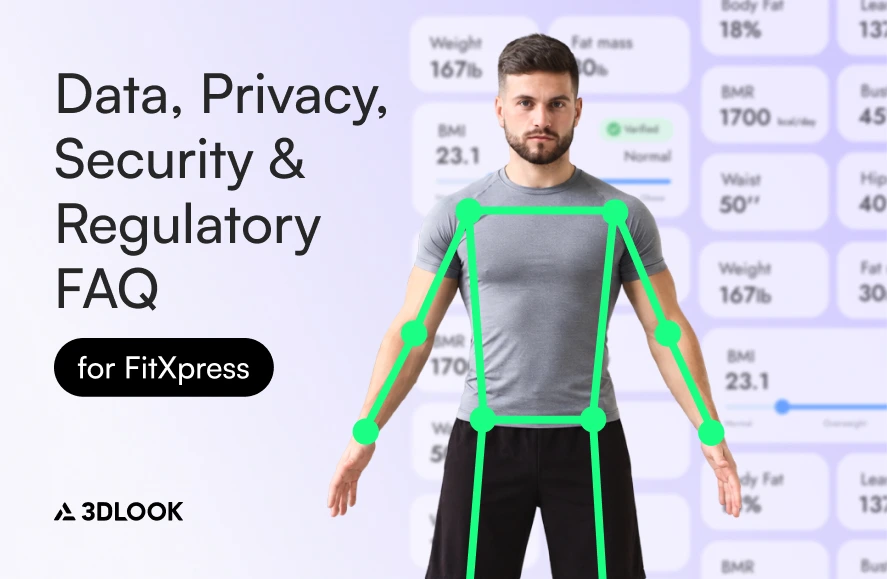
Additional implementation guidance is available in the Data, Privacy, Security & Regulatory Frequently Asked Questions for FitXpress.
Implementation considerations
Integration scope. An initial release can focus on one capture point, a defined set of outputs, and one comparison view. Display and storage responsibilities depend on the architecture and contractual terms.
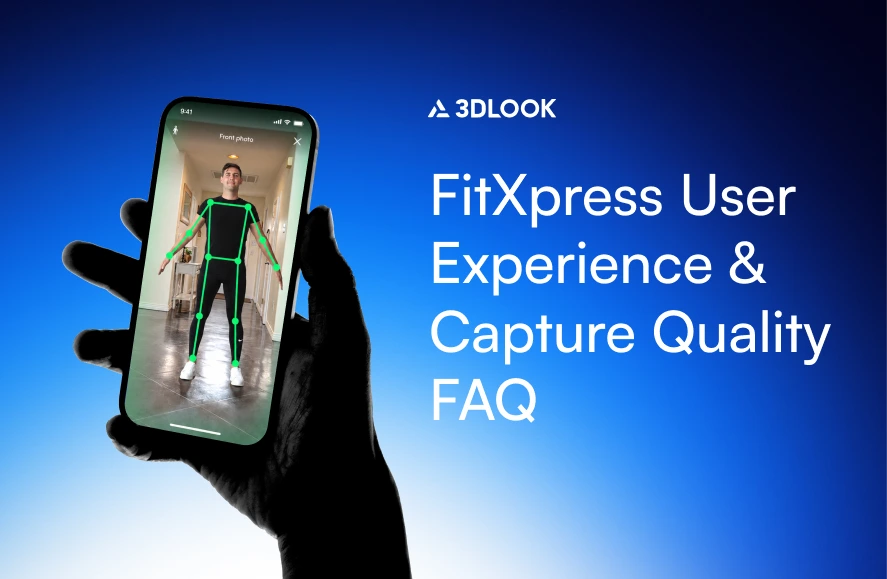
Capture protocol. Clothing, lighting, camera position, framing, and pose can affect quality. For detailed capture-quality and self-scanning guidance, see the FitXpress user experience and capture-quality FAQ.
Change thresholds. A meaningful-difference threshold should be determined by scan-to-scan variation, cadence, and the related action.
Accessibility and alternatives. Programs can define an alternative measurement method when the standard capture requirements cannot be met. Options include trained manual measurement, a scale reading, an in-person assessment, or a progress review that excludes the unavailable output. The record should identify the method because cross-method comparisons require separate interpretation.
How to evaluate a pilot
A pilot should test the complete workflow with representative clients and coaches. Each rate needs a predefined denominator and observation period.
- Capture completion rate: completed scans divided by initiated scans.
- First-attempt success and retake rate: successful first captures and additional capture attempts per participant.
- Usable comparison rate: participants with both a valid baseline and a valid follow-up result.
- Coach review time: time required to find, interpret, and discuss results during a check-in.
- Scheduled check-in completion: completed measurement check-ins divided by scheduled measurement check-ins.
- Support demand: scan-related requests by category and per active participant.
- Progress-view use: eligible clients who open or revisit the comparison view during the observation period.
- Alternative-path use: clients who require another measurement method, and whether that path supports the intended check-in.
- Privacy and access performance: completion of required notices and consent steps, authorized access tests, deletion tests, and incident handling.
Quantitative results should be reviewed alongside coach and client feedback on instruction clarity, workflow fit, output interpretation, and access barriers. Engagement and retention should be compared with a defined pre-pilot baseline or comparable cohort. Attribution also depends on changes in program content, seasonality, pricing, and cohort composition.
Best-fit coaching programs and limitations
Operational fit depends on roster size, delivery model, program duration, check-in cadence, and the need for consistent remote measurement. Potential use cases include:
- Subscription-based online fitness coaching with recurring progress reviews.
- Digital fitness platforms supporting multiple coaches and distributed client rosters.
- Hybrid personal-training businesses that continue structured coaching between in-person sessions.
- Time-bound remote fitness programs that require standardized baseline and completion records.
Evaluation commonly involves business, product, coaching, privacy, and technical stakeholders. Operational benefit may be limited when measurement is infrequent, assessments already occur in person, or longitudinal body data has no defined use.
FitXpress scope and limitations
FitXpress is not a medical device. It does not diagnose conditions, make clinical decisions, determine treatment eligibility, prescribe a fitness program, or establish the cause of a measured change.
Body-composition estimates and predicted weight from Smart Scales are supporting outputs. They are not equivalent to DXA, professional BIA, or a calibrated scale when a program, clinical protocol, legal requirement, or research method requires one of those references.
FitXpress captures structured body data remotely, supports a standardized capture process, and enables comparison across scans. Coaches and program operators remain responsible for selecting appropriate outputs, reviewing limitations, and determining how the information informs a fitness coaching workflow.
Conclusion and next steps
Mobile body scanning adds a structured remote measurement record alongside scale readings, progress photos, and other coaching information. Its value depends on consistent capture, clear output labels, appropriate change thresholds, defined privacy responsibilities, and a workflow that gives coaches the information required for a specific decision.
A pilot can test completion, retakes, usable comparisons, coach review time, client experience, support demand, accessibility, and privacy controls before a wider release. Explore FitXpress for connected and digital fitness or book a demo to review the workflow for a specific coaching program.
FAQ
Remote body measurement collects body data through a guided smartphone workflow. FitXpress uses front and side photos and relevant profile inputs to generate more than 80 model-generated measurements, body composition estimates, predicted weight from Smart Scales, and a 3D model. Processing typically completes in under 45 seconds.
Each method provides different information. A scale provides a direct weight reading, BIA estimates body composition through electrical impedance, and DXA provides imaging-based estimates. A mobile scan supports remote, repeated measurement. The required method depends on the decision, evidence standard, protocol, and access.
Internal validation against expert pattern-maker manual measurements showed approximately 96-97% agreement across the evaluated metrics, with a typical absolute error of 1.5-2.0 cm, depending on the measurement and body part. For most evaluated measurements, repeated scans showed typical scan-to-scan differences of less than 1 cm. Suitability depends on the decision, protocol, population, and acceptable error.
Data is encrypted in transit and at rest. Input photos are deleted immediately after processing or retained for up to 30 days depending on the business client’s instructions; retained photos are automatically blurred. Output retention depends on the deployment and customer policies.
FitXpress provides structured body data and scan-to-scan comparison. It does not recommend a program, diagnose a condition, make a clinical decision, or determine treatment eligibility. The coach or program operator remains responsible for interpretation and action.