Biometric screening in employer wellness programs
A single biometric screening day assumes every employee can attend, which remote and multi-site employees often cannot. The usual format puts a scale, a tape measure, a blood pressure cuff, and a blood draw in one place on one date.
KFF, the health policy research organization, defines a biometric screening as a health examination that looks at a person’s key health metrics. Its Employer Health Benefits Survey names cholesterol, BMI, blood pressure, and blood glucose. The aim is to assess general health and to identify risk factors. A US Office of Personnel Management (OPM) fact sheet describes worksite biometric testing as a screen for potential medical concerns.
Among firms offering health benefits in 2025, KFF found that 22% of firms with 10 to 199 workers offered a biometric screening. Among larger firms, the share was 43%. Of the firms that offer one, 61% allow employees to complete it remotely. KFF does not report the method. Since 2023, though, its survey question has included take-home kits.
Remote completion can mean a home blood kit or a home cuff reading as much as a phone scan. Which method fits depends on what each component needs: the body itself, a cuff, or a blood sample. AI body data for wellness platforms covers how wellness programs use body data beyond screening.
Scope note. FitXpress covers the body metrics in a biometric screening. Waist circumference is measured from two photos, BMI is calculated from height and weight, and body composition comes as estimates. Blood pressure and all blood tests, including cholesterol and glucose, are out of scope. FitXpress does not interpret results, assign health risk, or automate a reward or eligibility decision. Wellness-program compliance and incentive design stay with the employer and its counsel. FitXpress is not a medical device.
Short answer
- What does a biometric screening consist of? A screening usually covers height, weight, BMI, and blood pressure. It also includes blood values such as cholesterol, glucose, or hemoglobin A1C (A1C). Some programs add waist circumference or a tobacco question. KFF’s survey does not count smoking status as biometric screening.
- Which parts can a phone capture? The body measurements and the values built on them. Height is typed in, and weight comes from a home scale or self-report. A two-photo scan captures waist circumference, BMI follows from height and weight, and body composition arrives as estimates.
- Which parts need something else? Blood pressure needs a cuff. Cholesterol, glucose, and A1C need a blood sample. The sample is drawn at a lab or a screening event, or taken by finger prick with a home kit for some tests.
- How can employers run biometric screening remotely? As a hybrid. Body measurements run on the employee’s phone with body-scanning software such as FitXpress (3DLOOK). Blood pressure comes from an automatic upper-arm cuff at home or at a screening event. Blood work goes through a lab visit, a home collection kit, or an onsite event.
- Who interprets the results? The screening provider or the program’s clinicians.
If you are planning the body-measurement step, see how FitXpress supports body measurements for employee wellness programs.
What a biometric screening includes, component by component
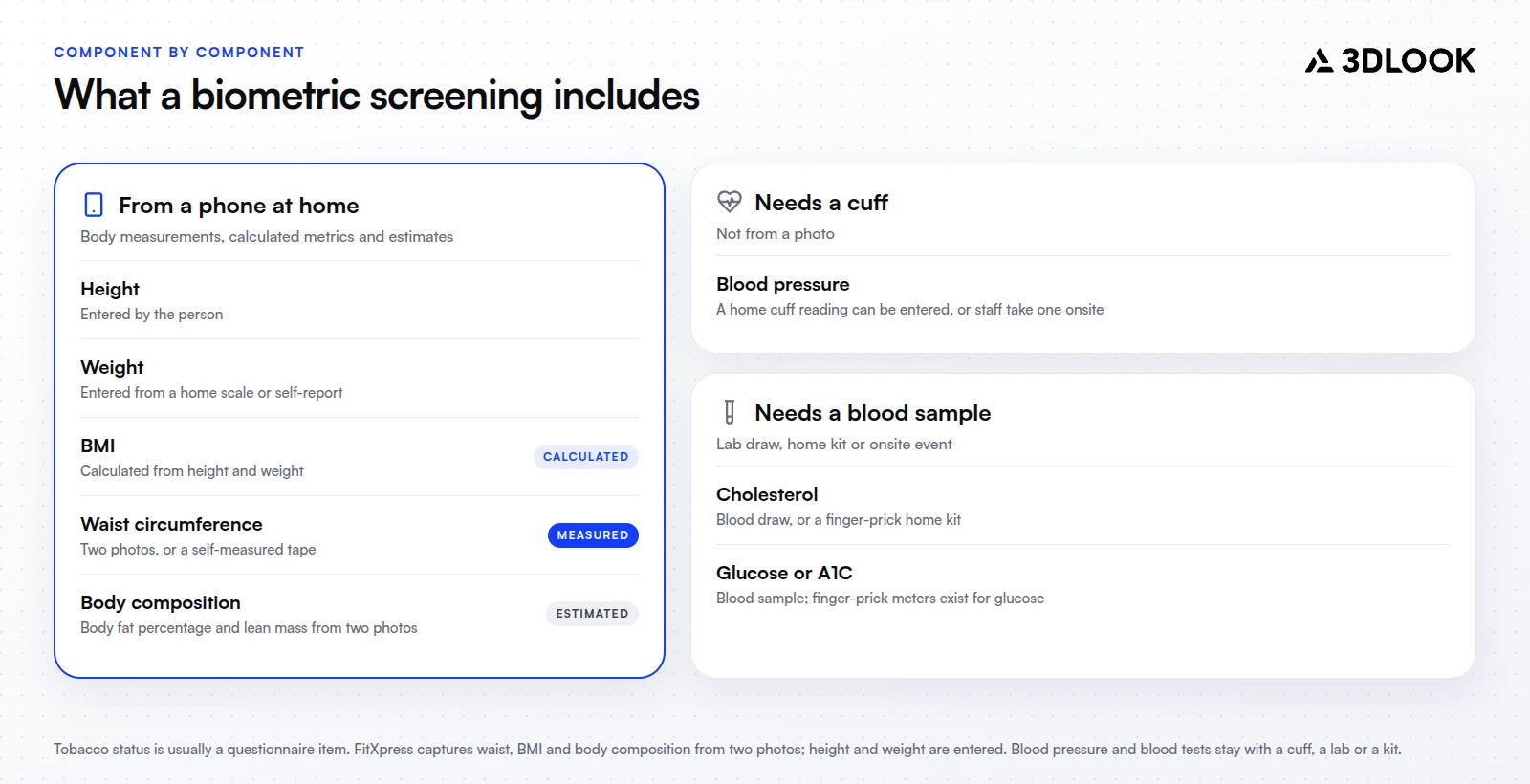
What is included in a biometric screening varies by program. OPM lists blood pressure, cholesterol, diabetes, and obesity, assessed with BMI. Each component has a usual collection method, and some of those methods also work at home.
| Component | How it is usually collected | From a phone at home? | Notes |
|---|---|---|---|
| Height | Measured by staff at an event or clinic | Entered by the person | FitXpress takes height as an input and does not measure it |
| Weight | Scale at the event or clinic | Entered from a home scale or self-report | Used with height to calculate BMI |
| BMI | Calculated from height and weight | Yes, calculated | The Centers for Disease Control and Prevention (CDC) calls BMI a screening measure, read with other factors |
| Waist circumference | Tape just above the hip bones, read after breathing out, per the National Heart, Lung, and Blood Institute (NHLBI) | Yes: a self-measured tape, or two photos with FitXpress | The program confirms its waist definition |
| Body composition (body fat percentage, lean mass) | Not in the KFF or OPM definitions; added by some programs | Yes, as estimates from two photos with FitXpress | Where a protocol names a reference method, that method stays |
| Blood pressure | Cuff reading at the event or clinic | Not from a photo; a home cuff reading can be entered | The American Heart Association (AHA) recommends a validated, automatic upper-arm cuff |
| Cholesterol (lipid profile) | Blood draw (CDC) | Only with a home kit that uses a finger prick (MedlinePlus) | May require fasting (CDC) |
| Glucose or A1C | Blood sample from a vein (MedlinePlus) | Finger-prick meters exist for glucose | A1C reflects average blood sugar over the past 3 months and needs no fasting (CDC) |
| Tobacco status | A questionnaire item or a separate test | An answer can be given online | Not counted as biometric screening in KFF’s survey |
Height, weight, BMI, waist circumference, and body composition describe the body itself, and all five can move to a phone at home. The remaining components each need a cuff, a sample, or a question.
What a phone can capture: measurements, calculated metrics, and estimates
At home, height and weight become typed entries; the other three come from the scan or a calculation.
Height and weight
At a screening event, staff measure height and weigh the person on a scale. At home, the person enters height, along with a weight from a home scale or from memory. Any error in either input carries into BMI. FitXpress uses those entered values, together with the two photos. A program that requires a weight taken by staff keeps that step in its protocol.
BMI
BMI is calculated from height and weight, onsite or at home. The CDC calls BMI a screening measure and says it should be considered with other factors when assessing health. FitXpress returns BMI as a calculated metric, the same output used in BMI verification.
Waist circumference
The NHLBI links a larger waist to a higher risk of heart disease and type 2 diabetes, which is one reason programs measure it. Its protocol is short. The person stands, the tape goes around the middle just above the hip bones, and the reading is taken just after breathing out. At home, a self-measured reading depends on where the person places the tape.
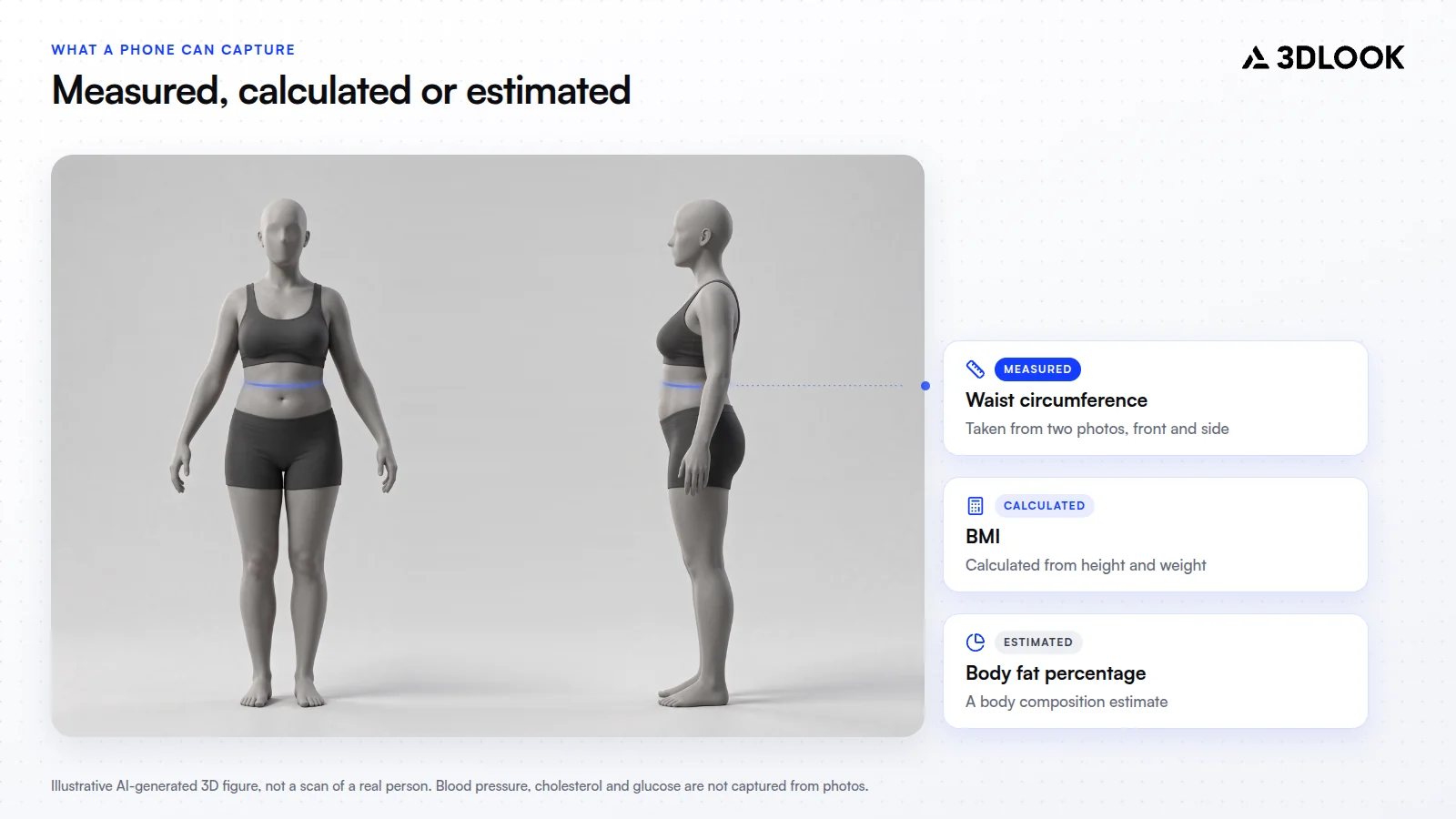
FitXpress measures waist circumference from two photos, front and side. It is one of 80+ body measurements, which include circumferences, lengths, and widths. Before comparing scan values with tape readings, the program confirms that the waist definition matches its own protocol.
Body composition estimates
Body composition is not in the KFF or OPM definitions. Some programs add it to look beyond BMI at how body weight divides between fat and lean mass. FitXpress returns body fat percentage, lean mass, and fat mass as estimates, and basal metabolic rate (BMR) as a calculated metric. A program whose protocol names a reference method for body composition keeps that method.
What still needs a cuff, a lab, or a kit
At home, blood pressure still needs a cuff. The AHA recommends an automatic, cuff-style, upper-arm monitor that has been validated. It does not recommend wrist or finger monitors, which it says give less reliable readings. The program collects the employee’s reading from that cuff.
Cholesterol is checked with a lipid profile. According to the CDC, the test needs a blood draw and may require fasting. Glucose and A1C also need a blood sample, and the CDC notes that the A1C test needs no fasting.
Some of these tests have home versions. MedlinePlus describes at-home cholesterol kits that collect a drop of blood with a finger prick, and home glucose meters work the same way.
Tobacco status, where a program includes it, is an online questionnaire answer or a separate test.
Blood pressure, cholesterol, glucose, and other blood tests are out of scope for FitXpress.
How employers combine phone, kit, and onsite steps
A remote screening is usually a hybrid, with each component sent to the channel that can collect it. A program can run it in five steps.
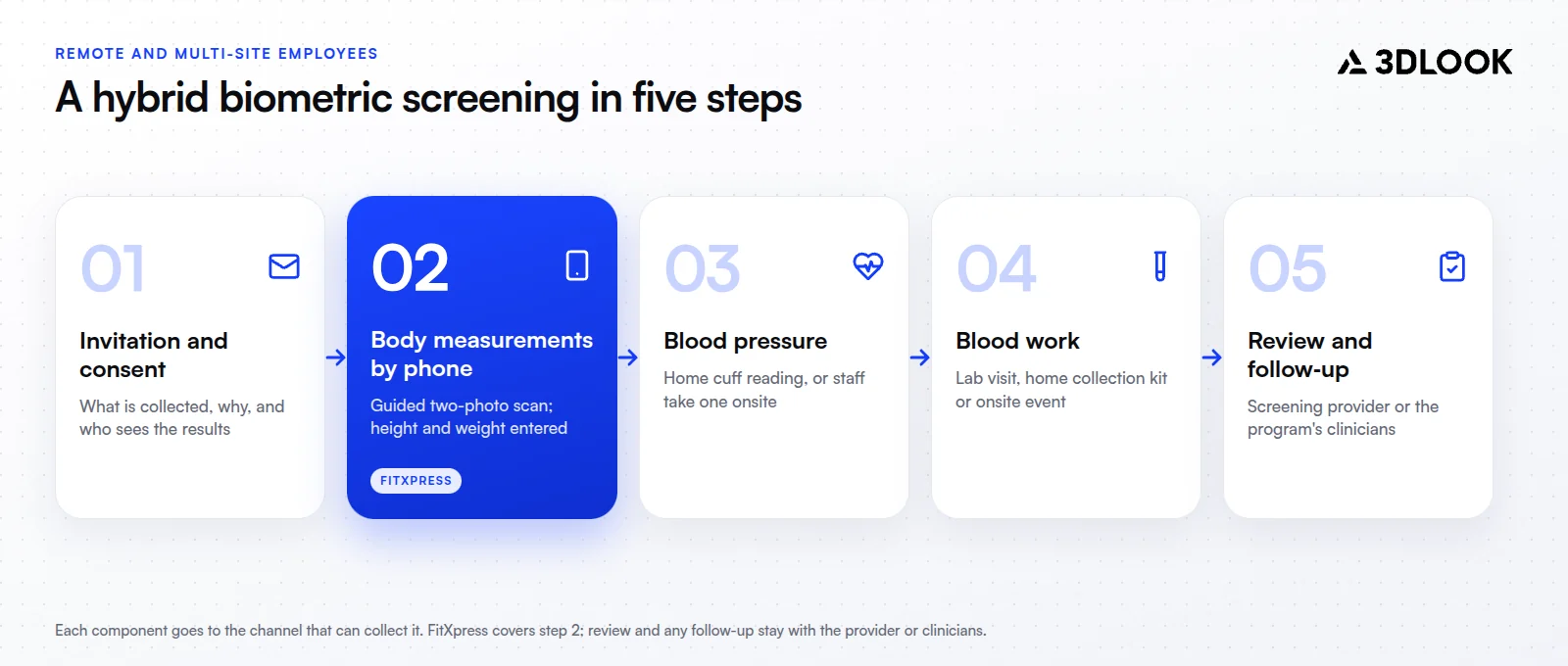
- Invitation and consent. The program tells employees what is collected, why, and who sees the results.
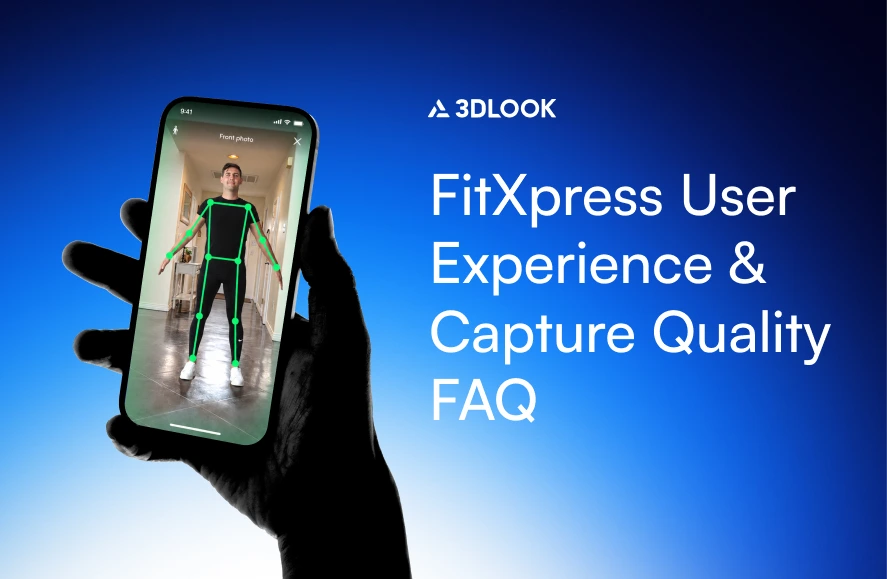
- Body measurements by phone. The employee completes a guided two-photo scan and enters height and weight. Results go to the program’s own system.
- Blood pressure. The employee enters a home cuff reading, or staff take one at an onsite event.
- Blood work. The employee visits a lab, uses a home collection kit, or attends an onsite biometric screening event.
- Review and follow-up. The screening provider or the program’s clinicians review results and handle follow-up.
FitXpress was not specifically trained on data representing people with physical disabilities, and its measurement performance has not been established for this population. This matters when a disability affects the standard standing pose or capture sequence. In those cases, the program needs a documented alternative measurement path. For those employees, the path can be an onsite or staff-taken measurement.
Where FitXpress fits
FitXpress runs the scan from two photos, front and side, and returns structured outputs in under 45 seconds. The program receives body measurements, calculated metrics such as BMI, and body composition estimates as timestamped records. Delivery runs through the application programming interface (API) and software development kit (SDK) into the employer’s or wellness vendor’s own platform. The FitXpress Admin Panel is an optional interface for monitoring and exporting results, and it does not replace integration.
Interpretation stays with the screening provider and the program’s clinicians. FitXpress does not independently determine a diagnosis, employment eligibility, insurance eligibility, or any other high-impact individual decision. Rewards tied to body data run as a separate workflow, wellness rewards verification.
FitXpress makes no wellness-program compliance claim under the Americans with Disabilities Act (ADA) or the Genetic Information Nondiscrimination Act (GINA). The same holds for Equal Employment Opportunity Commission (EEOC) rules and the Health Insurance Portability and Accountability Act (HIPAA). Incentive design for a wellness program is the employer’s call, made with counsel.
Data handling is a separate question from program compliance. FitXpress can support HIPAA-governed deployments where 3DLOOK acts as a business associate under an executed business associate agreement (BAA), where applicable. In most enterprise deployments, the customer acts as the data controller and 3DLOOK acts as the data processor under the General Data Protection Regulation (GDPR). Scan records are associated with anonymized, randomly generated IDs; 3DLOOK cannot identify a specific individual from stored scan records. Storage, retention, and deletion answers are in the FitXpress data, privacy, security and regulatory FAQ.
Before moving the body-measurement step to a phone
Home conditions differ from a screening room. Lighting, clothing, and phone angle vary from one employee to the next, and each can affect a scan.
A pilot can start with a small group of employees scanning on their own phones. The program then compares the waist definition and the returned outputs with its protocol. The pilot also shows how many employees need the alternative measurement path.
The screening provider and the program agree how body measurements and blood results reach the same employee record. In a hybrid screening, that join often takes more planning than the scan itself, because the two sets of results arrive from different systems.
FAQ
Is a biometric screening the same as a physical?
No. In KFF’s definition, a biometric screening records a set list of health metrics, such as blood pressure and cholesterol. In a physical examination, a health care provider checks the body to determine whether there is a physical problem. Pre-employment and fitness-for-duty exams are a separate process again, covered in pre-employment and fitness-for-duty screening.
Does a biometric screening test for drugs?
Not by the common definitions. Neither the KFF definition nor the OPM fact sheet lists drug tests. KFF’s survey also leaves smoking status out. Drug testing, where an employer uses it, runs as a separate program.
How accurate are body measurements taken from phone photos?
What counts as adequate performance depends on how the measurements will be used. 3DLOOK’s published figures compare FitXpress with expert tape measurements, which serve as the reference. The relevant question is whether the reported error and repeatability are suitable for the intended workflow.
Repeatability testing used a real-world customer dataset with five scans per participant. For most of the evaluated measurements, typical scan-to-scan differences remained below 1 cm. The 3DLOOK body-scanning accuracy framework describes the test conditions.
A separate validation compared FitXpress measurements with expert pattern-maker tape measurements. Across the evaluated body measurements, reported accuracy was approximately 96-97%, with a typical absolute error of 1.5-2.0 cm depending on the body part. Detailed methodology is available under a non-disclosure agreement, and the accuracy framework sets out the reference and conditions.
Next steps
List the components the program needs, and mark which ones need a cuff or a blood sample. Then talk to 3DLOOK about the body-measurement step.