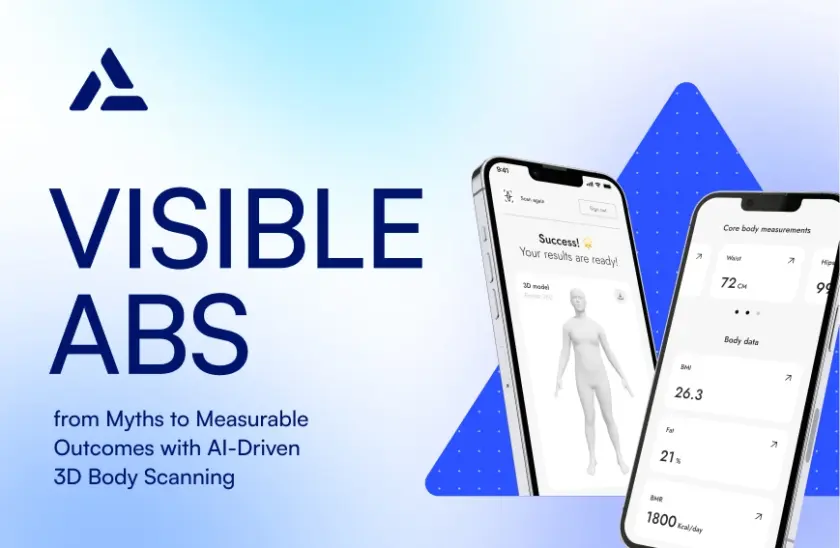
Why this article matters
This article is written for digital health, fitness, and wellness platforms looking to track body composition progress beyond BMI and self-reported metrics. It reflects practical product and industry insights around measurement-based motivation and retention (not medical advice).
By 3DLOOK Research and Product Team
We work at the intersection of computer vision, digital health, and body measurement technology, collaborating with platforms that need accurate, scalable progress tracking and better user engagement.
One of the Most Appreciated Fitness Goals
From first-time gym members to semi-professional athletes, achieving visible abs remains one of the most frequently stated goals among fitness enthusiasts. In onboarding surveys, progress check-ins, and day-to-day conversations with coaches, the “six-pack” often becomes shorthand for discipline, health, and confidence.
Based on 3DLOOK’s experience working with digital health and wellness products, “visible abs” is rarely just an aesthetic wish. It serves as a motivational anchor: a goal that users instantly understand, and one that can keep them engaged when progress feels slow.
Despite its popularity, abs visibility is widely misunderstood. Many users expect the abs to “switch on” once a specific number appears on a scale or body-fat chart. In reality, abs are the cumulative result of localized changes that are highly individual and often invisible long before they become apparent in the mirror.
Leading platforms are responding by reframing abs as a trajectory, not a threshold: a pattern of shape and measurement trends that can be tracked over time.
Let’s clarify what drives abs visibility and how 3D body scanning helps modern digital programs move beyond BMI to deliver more precise, more motivating feedback.
What Are Visible Abs and What Drives Abs Visibility?
The anatomy behind the “six-pack” is more complex than the term suggests, and its key structures include:
- Rectus abdominis: the primary “six-pack” muscle running vertically from the ribs to the pubic bone
- Linea alba: a connective tissue line separating the left and right sides down the center
- Tendinous intersections: horizontal fascia bands that create the segmented “packs”.
Visible abs represent prominent and developed abdominal muscles showing through the skin when the subcutaneous fat layer covering the abdomen is thin enough.
While “abs” are often treated as a pop-fitness aesthetic target, the abdominal muscles are also essential for posture, spinal stability, and efficient movement. A stronger core supports daily motions (lifting, reaching, bending) and can reduce injury risks during training and in everyday life.
The common motivation killer is that abs do not appear at a single number. They emerge gradually and unevenly: the upper abs often become visible earlier, while the lower abdomen typically holds fat longer.
Abs visibility can also be shaped or limited by individual anatomy (body structure, posture, overall fat distribution) and biomechanics. Even at the same weight or body-fat percentage, people can look different due to:
- genetics and hormonal factors
- muscle thickness and training history
- fat distribution (especially lower abdomen)
- posture and core engagement
- torso length and rib cage structure.

Discover how AI-powered body intelligence is reshaping GLP-1 programs, telehealth, and digital health, from accurate remote assessments to safer and more engaging patient journeys.
Understanding Body Fat and Abs Visibility Stages
Although body fat percentage is typically discussed as a single number, it includes different functional types:
- Essential fat: minimum fat needed for basic physiological function
- Visceral fat: fat stored deeper around organs, associated with a higher health risk
- Subcutaneous fat: the layer under the skin that most directly affects shape and muscle visibility
Motivated by visible abs, users often focus on body-fat percentage: the proportion of fat tissue relative to total body weight. Yet abs visibility is not a fixed switch and exists on a spectrum:
- Slight definition: upper abs begin to show faintly
- Moderate definition: upper and some middle abs visibility; lower abs less defined
- Complete definition: most of the “six-pack” becomes clearly visible
- High definition: maximal separation plus visible obliques
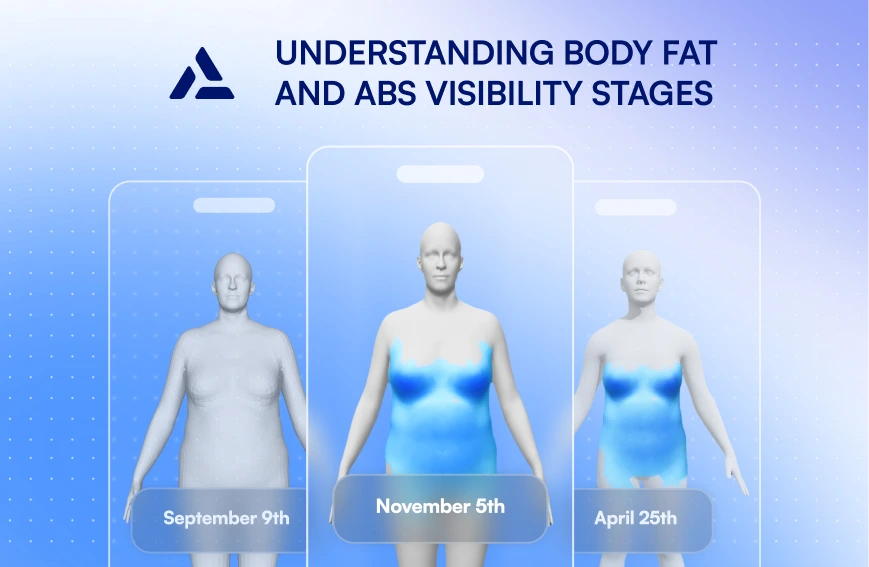
In real digital programs, many users experience fundamental physiological changes without immediate visual rewards, known as invisible progress. Despite objectively improving outcomes, if your platform cannot demonstrate users’ progress early on, the risk of drop-off increases.
Typical Body Fat Ranges Where Abs Start to Show (Practical Guidance)
Important note: these ranges are practical estimates. Visibility depends on factors such as muscle development, fat distribution, posture, and individual biology. The goal for platforms is not to promise abs at a number, but to track and explain progress safely and transparently.
Body Fat Percentage for Visible Abs in Many Men
Many men begin to see upper ab definition somewhere around the low to mid-teens body fat percentage. While a complete definition often requires even lower levels that may be difficult to sustain.
| Abs visibility | Body fat percentage |
| Slight definition | 15-17% |
| Moderate definition | 12-14% |
| Complete definition | 10-12% |
| High definition | Below 10% body fat |
Body Fat Percentage for Visible Abs in Many Women
Women naturally require higher body fat for healthy hormonal function. Many women develop strong core tone without pronounced visual separation, and very sharp definition may require levels that are not sustainable or advisable for everyone.
| Abs visibility | Body fat percentage |
| Slight definition | 22-24% |
| Moderate definition | 19-21% |
| Complete definition | 16-18% |
| High definition | Below 16% body fat |
When Abs May Not Be Visible Even at “Low” Body Fat
The frustration often begins here: a user reaches a target body-fat percentage, but their abs still appear underwhelming.
Common reasons include:
- fat loss is not evenly distributed (the lower abdomen often changes later)
- abdominal muscle thickness is still developing
- posture and pelvic alignment affect how the abs present visually
- water retention, stress, sleep, and recovery can temporarily blur the definition
- genetic influence where fat is stored and how the midsection looks at the same “number”
That explains why “one metric” programs can create confusion and false plateaus, even when users are progressing.
The Limits of Body Fat Percentage as a Progress Metric
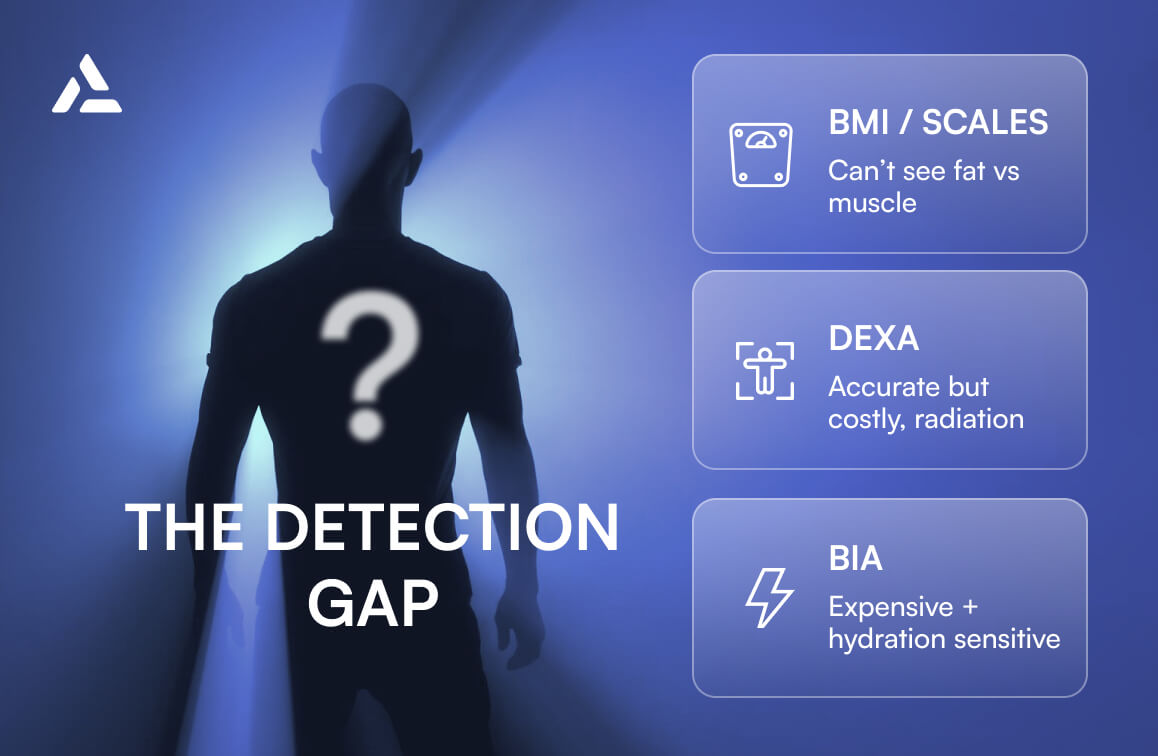
Body-fat percentage is more informative than weight or BMI, but it still cannot answer the questions users care about most:
- Why are my abs not visible even if my body-fat percentage is “low”?
- Where exactly did I lose fat?
- How is my torso shape changing over time?
- Am I losing muscle as I diet down?
For digital platform users, relying only on body-fat percentage can lead to:
- demotivation due to “invisible progress”
- confusing feedback loops and inconsistent decisions
- unrealistic expectations and overtraining tendencies
For this very reason, more advanced approaches are gaining traction. As one practical solution, 3D body scanning shifts the focus from thresholds to trajectories.
How 3D Body Scanning Improves Tracking Toward Visible Abs
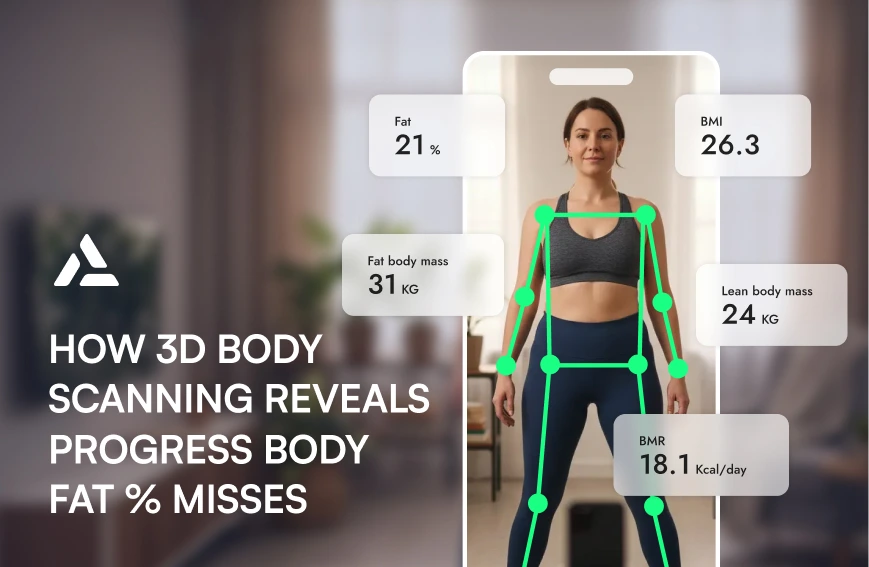
3D body scanning enables a shape-based and localized approach to progress tracking.
Using 3DLOOK’s mobile 3D body scanning technology, platforms can generate 3D body models and extract detailed anthropometric measurements using only two smartphone photos:
- tracking waist, hip, and abdominal measurements over time
- visualizing torso proportion and shape changes
- identifying progress from “day zero” long before abs become visibly defined
With FitXpress, platforms can show where change is happening instead of asking users to trust a single number.
FitXpress also supports scan quality through guided capture (for example, helping users follow pose and clothing requirements), which can reduce resubmissions and drop-offs during onboarding and recurring check-ins.
Industry insight
In many programs, users start to lose centimeters in their waist and abdomen weeks before they see a clear definition. Showing those localized trends early is one of the simplest ways to reduce churn and maintain high motivation.
Final Thoughts
Visible abs will likely remain one of the most powerful fitness goals. The opportunity for modern digital health and wellness platforms is not to promise abs at all costs, but to explain progress in a personalized, measurable, and, most importantly, sustainable way.
Integrating 3D body scanning technologies into the platforms helps businesses:
- replace guesswork with visual evidence
- answer complex user questions with data
- build trust through clarity and transparency
Helping users see progress, even before it becomes evident in the mirror, is often the missing piece in long-term engagement.
Health disclaimer
This content does not constitute medical advice and is provided only for educational purposes. Individual results vary based on health conditions, genetics, training history, and lifestyle factors.